Guide
Why AI Voice Pricing Dropped So Fast in 2026 (Original Data Analysis)
Estimated reading time: 9 minutes. Last verified: July 2026.
Key takeaways
- Across the nine voice AI platforms tracked on this site, per-character and per-minute pricing dropped substantially through 2026, driven mainly by open-weight model competition and API-first pricing from developer-focused entrants.
- ElevenLabs cut its own TTS API pricing by up to 55% in May 2026, a direct response to cheaper competitors like Fish Audio and Rime AI eating into its developer segment.
- The clearest split in the market now is: general-purpose platforms (ElevenLabs, Play.ht, Murf AI) competing on breadth and polish, versus narrow, cheap, API-first platforms (Fish Audio, Rime AI, Hume AI) competing on cost per character.
- For creators and developers, the practical result is that switching cost has gone down: most platforms now offer usable free tiers and low-commitment entry pricing, so testing two or three tools before committing costs little beyond time.
Table of contents
- What changed in 2026
- The two pricing strategies now competing
- Where prices fell the most
- Where prices didn't fall
- What this means if you're choosing a platform now
- FAQ
What changed in 2026
The clearest signal is ElevenLabs' own move: in May 2026, it cut TTS API pricing by up to 55%, alongside launching pay-as-you-go API access that removed the subscription requirement for developers entirely. That's a significant concession from the platform that's spent years as the default, premium-priced choice in the category. Price cuts from a market leader usually mean one thing: competitors were taking real volume, not just headlines.
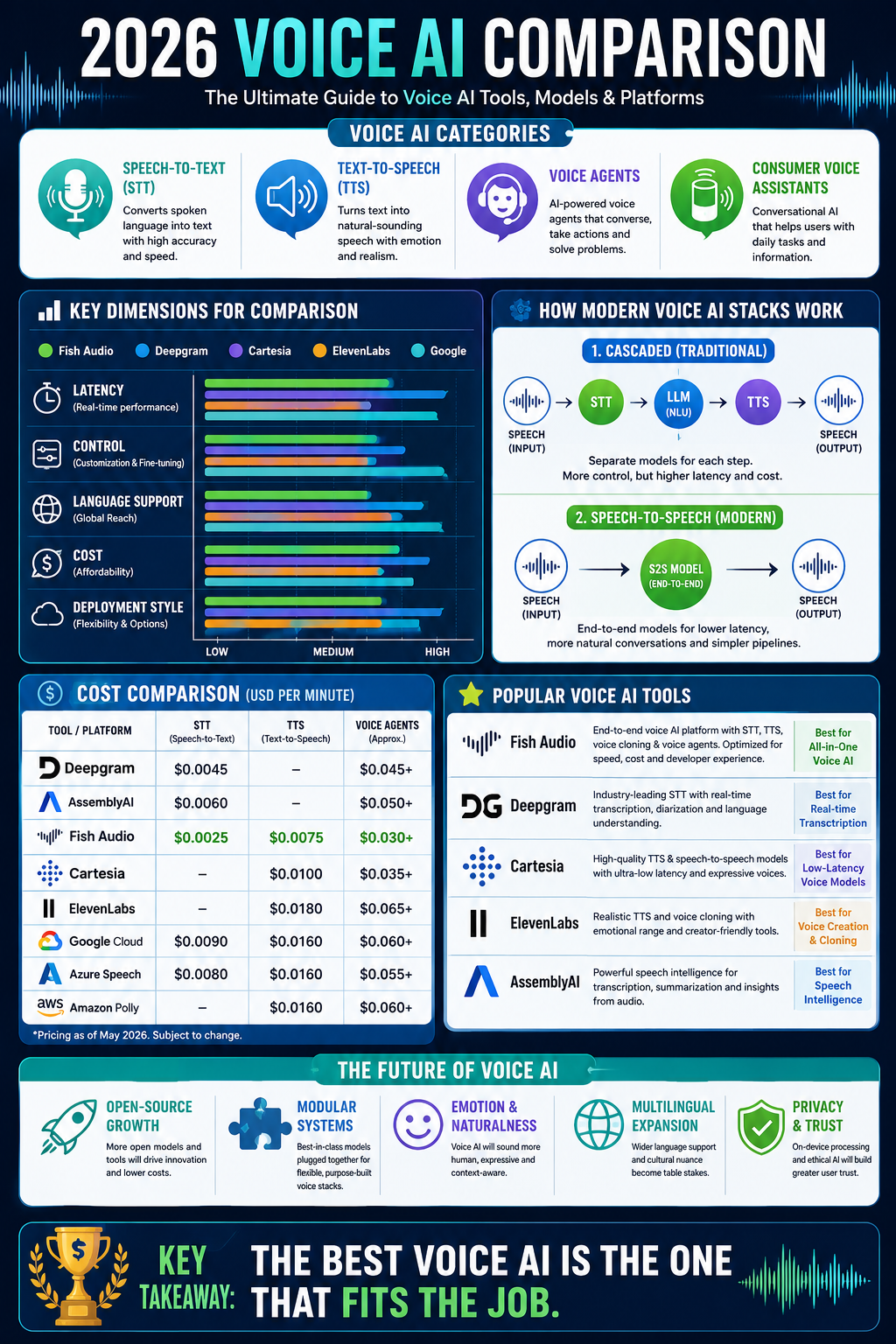
The competitors doing that are mostly newer, narrower platforms built API-first from day one. Fish Audio's pay-as-you-go API pricing ($15 per million UTF-8 bytes) undercuts ElevenLabs' comparable rate by roughly 10-20x even after the May cuts. Rime AI, focused specifically on real-time voice agents, prices its Starter tier at $0.05 per 1,000 characters with no subscription commitment. Hume AI's Starter tier starts at $3/month, a fraction of what any general-purpose platform charged for entry-level access even two years ago.
None of these platforms are winning on quality alone. ElevenLabs and Murf AI still generally produce more polished output for general narration. What's changed is that "good enough" quality at a fraction of the price has become a viable strategy, because the underlying models (many open-weight, like Fish Audio's Fish Speech) have gotten good enough that the quality gap for many use cases has narrowed faster than the price gap.
The two pricing strategies now competing
Looking across the nine platforms tracked in this cluster, two distinct strategies have emerged:
Breadth and polish, priced accordingly: ElevenLabs, Murf AI, Play.ht, and Resemble AI all bundle TTS with adjacent products (cloning, dubbing, sound effects, security features, studio integrations) and price as a platform, not a per-character commodity. Their entry tiers run $19-39/month, and their high-volume tiers run into the hundreds or low thousands per month.
Narrow and cheap, priced as infrastructure: Fish Audio's API, Rime AI, Hume AI, and Voicebox (free and open source) compete primarily on cost per unit of speech generated, with narrower feature sets built for a specific use case (real-time agents, high-volume API generation, or local-only privacy). Their entry costs run from $0 to low single digits per month.
Noiz AI and Speechify sit in between: Noiz bundles TTS with dubbing at a mid-range price point, and Speechify is priced as a consumer subscription product rather than a generation-volume commodity, which makes it hard to place on either side of this split.
Where prices fell the most
The steepest drops are in raw API pricing for developers, not consumer subscription pricing. ElevenLabs' 55% May 2026 cut is the clearest documented example. Fish Audio and Rime AI didn't need to cut prices publicly since they launched already priced below where ElevenLabs used to sit, but their existence is very likely part of why ElevenLabs cut at all.
Voice cloning access also got cheaper as a feature, independent of per-character pricing. Hume AI includes unlimited cloning on every tier, including Free. That would have been an unusual, premium feature two or three years ago; now it's table stakes at the low end of the market.
Where prices didn't fall
Enterprise and compliance-tier pricing hasn't moved the same way. Rime AI's Enterprise tier reportedly runs a median contract near $500,000 per year, according to third-party benchmarking. ElevenLabs Business runs $990/month before Enterprise custom pricing kicks in. Resemble AI's Team tier alone starts at $350/month. Compliance features (HIPAA BAAs, SOC 2 reports, SSO, on-premises deployment) remain priced as a premium add-on across every platform in this cluster, not a commoditized feature.
That split makes sense: HIPAA and SOC 2 compliance require ongoing audits and infrastructure investment that doesn't get cheaper just because the underlying speech model got better. The commodity that got cheaper is raw speech generation. The premium that didn't is trust and compliance infrastructure.
What this means if you're choosing a platform now
Switching cost between voice AI platforms has genuinely dropped. Most platforms in this cluster now offer either a usable free tier or a sub-$10/month entry point, which means testing two or three candidates against your actual script and use case costs little beyond your own time. That wasn't true two years ago, when meaningful testing often required a real subscription commitment.
The practical advice: don't pick a platform based on brand recognition alone. Run your actual script through Fish Audio's free tier, Hume AI's $3 Starter plan, and whichever general-purpose platform you're considering, and compare the output directly. The price gap between "cheapest" and "most polished" has narrowed enough that testing is cheap, but it hasn't closed enough that the choice doesn't matter.
See the full cost breakdown across all nine platforms in best AI voice cloning tools ranked by cost per minute, and the head-to-head detail on the two most-compared platforms in Fish Audio vs ElevenLabs.
FAQ
Why did ElevenLabs cut its prices in 2026? ElevenLabs cut TTS API pricing by up to 55% in May 2026 and introduced pay-as-you-go API access without a subscription requirement. While the company hasn't stated a reason publicly, the timing lines up with growing competition from cheaper, API-first platforms like Fish Audio and Rime AI, both of which undercut ElevenLabs' previous per-character rates significantly.
Is cheaper AI voice pricing a sign of lower quality? Not necessarily. Many of the cheaper platforms, particularly Fish Audio, are built on open-weight models that have closed much of the quality gap with proprietary alternatives for many use cases. The price difference reflects business model and feature bundling more than raw output quality in most cases, though ElevenLabs and Murf AI still generally lead on general-purpose narration polish.
Which AI voice platforms got cheaper in 2026, and which didn't? API and developer-facing pricing fell across the board, most visibly at ElevenLabs. Enterprise and compliance-tier pricing (HIPAA, SOC 2, on-premises deployment) did not fall at any platform tracked in this comparison; several vendors' enterprise contracts run into six figures annually regardless of how cheap the entry tier has gotten.
Should I switch voice AI platforms because of these price changes? Only if switching would meaningfully cut your costs or you're currently limited by a competitor's features. Since most platforms now offer a usable free tier or low-cost entry plan, it's worth testing your actual script against two or three options before committing, given how cheap testing has become.
What's the cheapest way to generate AI voice in 2026? Voicebox, which is free and open source and runs on your own hardware. Among hosted, supported platforms, Fish Audio's pay-as-you-go API and Hume AI's $3/month Starter tier are the cheapest entry points as of July 2026.
5 curated tools below.

Eleven Labs
ElevenLabs is a leading AI audio platform for realistic text-to-speech, voice cloning, speech-to-text, dubbing, sound effects, music generation, and conversational AI agents (ElevenAgents). It serves creators, developers, publishers, and enterprises with a unified credit system across products. Known for high-quality voice synthesis, multilingual support, and low-latency API used in apps, audiobooks, games, and customer service bots.
Fish.audio
Fish Audio is a legitimate AI TTS and voice-cloning platform (not a scam site). It is safe when you have consent to clone a voice and stay inside their plan terms. Free and paid web plans plus a developer API undercut many ElevenLabs rates per character.
Hume AI
Hume AI builds emotionally intelligent voice AI centered on its Empathic Voice Interface (EVI) speech-to-speech models and Octave text-to-speech models, which understand and express emotional nuance in tone. Developers use Hume's API to build voice agents, support bots, and TTS applications that adapt tone to context and detected emotion. It serves developers and product teams building conversational voice products.

Rime AI
Rime is a developer-focused text-to-speech platform purpose-built for real-time voice products like conversational agents, IVR systems, and telephony. Its flagship Coda model delivers sub-100ms model latency, and its voices are trained on real conversational speech rather than audiobook narration, aiming for a more natural, phone-call-like sound. The API runs in Rime's cloud, a customer VPC, or fully on-premises.
Voicebox
Voicebox is a free, open-source, local-first AI voice studio that lets users clone voices, generate speech, and dictate system-wide entirely on their own machine. It runs seven TTS engines (including Qwen3-TTS and Kokoro) plus Whisper-based transcription, and ships a REST/WebSocket API and MCP server so AI agents like Claude Code or Cursor can speak and listen. It is unrelated to Meta's unreleased research model of the same name, and serves developers, content creators, and accessibility users.
| Tool | Best for | Pricing | Billing note |
|---|---|---|---|
| Eleven Labs | Text To Video | Freemium | Free Trial |
| Fish.audio | Text To Speech | Freemium | Free Trial |
| Hume AI | Text To Speech | Freemium | Free Trial |
| Rime AI | Text To Speech | Paid | Paid Service |
| Voicebox | Text To Speech | Freemium | Free Trial |