Battle Of the Voice AI TTS
Fish Audio vs ElevenLabs: Cost, Quality, and Use Cases (2026)
Estimated reading time: 12 minutes. Last verified: July 2026.
Key takeaways
- Fish Audio wins on cost, character-driven expressiveness, API scale, and self-hosting. Its API runs about $15 per million characters, against roughly $150-$300 per million on ElevenLabs' comparable tiers.
- ElevenLabs wins on studio tooling, dubbing, team collaboration, and low-latency conversational agents (as low as 5 cents a minute on the Business plan).
- In blind listening tests, Fish Audio's S2 Pro model often scores higher for raw naturalness and emotional range. ElevenLabs scores higher for consistency across long-form, production-ready output.
- If you're generating high volumes of speech and cost per character matters, Fish Audio is usually the cheaper path. If you need a managed studio with dubbing, team seats, and enterprise SLAs, ElevenLabs is the safer default.
Table of contents
- Platform overview
- Feature comparison
- Pricing comparison
- Voice quality and output
- Which should you choose?
- FAQ
Platform overview
Both platforms turn text into speech. The difference is who they're built for.
Fish Audio
Fish Audio is a developer- and creator-first TTS platform built on the S1, S2, and S2 Pro model family. It leans into expressive speech: inline emotion tags, word-level prosody control, fast voice cloning, and open weights that support self-hosting for teams with the GPU budget for it. Typical buyers: VTubers, game studios, and anyone generating speech at volume through an API.
References: Fish Audio TTS, S2 model, capabilities docs
ElevenLabs
ElevenLabs is a closed-source, commercial voice AI platform built for polished narration, dubbing, and enterprise workflows. It ships instant and professional voice cloning, a Dubbing Studio, voice isolation, and team workspace tools aimed at production consistency. Typical buyers: audiobook publishers, marketing teams localizing video, and companies shipping customer-facing voice products.
References: ElevenLabs pricing, text-to-speech docs
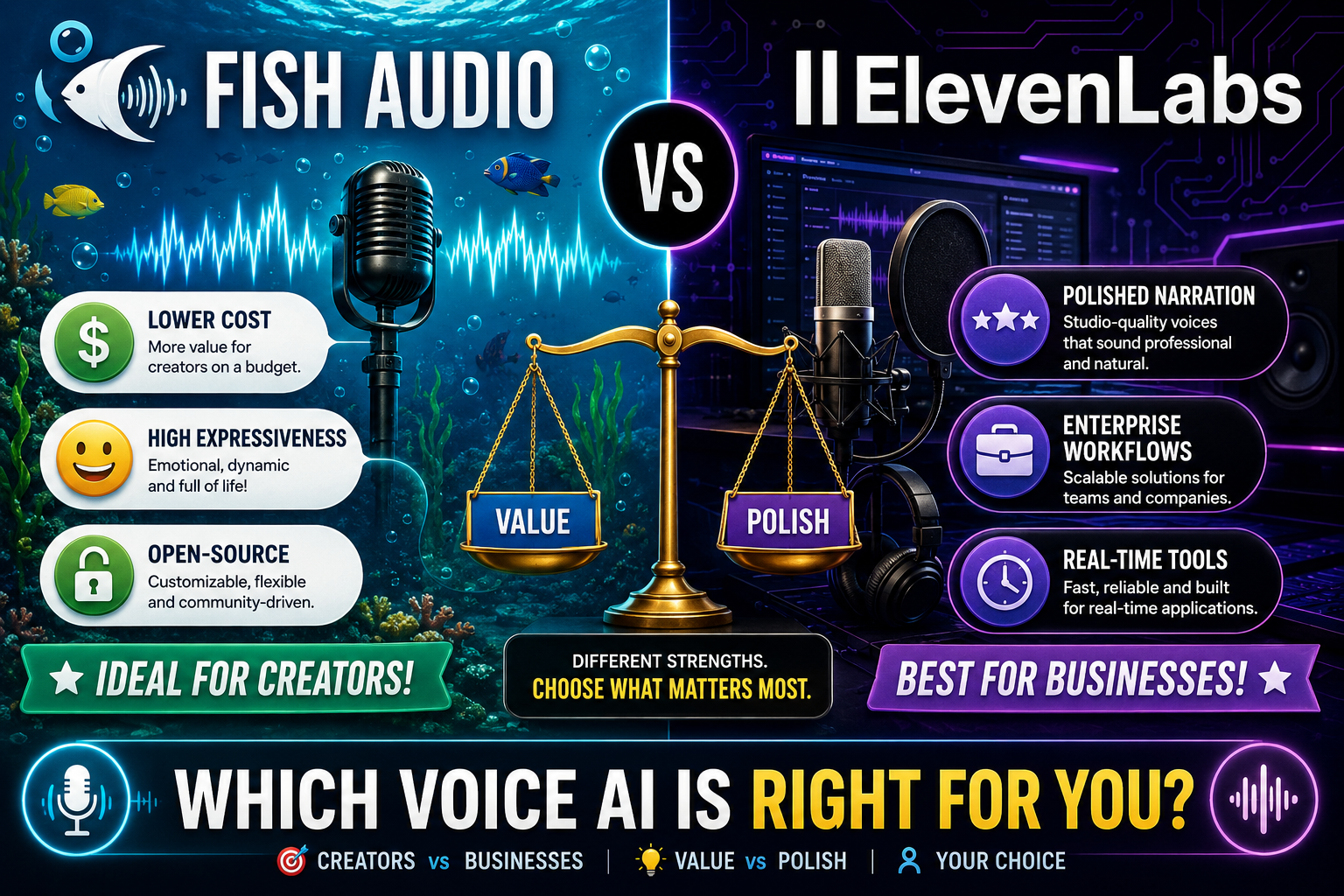
Fish Audio vs ElevenLabs in one line: Fish Audio trades some production polish for lower cost and more expressive control. ElevenLabs trades some cost for a more complete studio and enterprise workflow.
Feature comparison
Models and architecture
Fish Audio runs the S2 Pro, S2.1 Pro, and S1 model family, built around fine-grained expressiveness, with some weights available for self-hosting. ElevenLabs runs proprietary, closed models (Multilingual v3, and the Flash/Turbo family for low latency), tuned for stability and speed inside a managed cloud service.
| Criteria | Fish Audio | ElevenLabs |
|---|---|---|
| Openness | Open-weight models available | Closed, cloud-only |
| Best for experimentation | Yes | No |
| Best for managed production | Partial | Yes |
Language support and cross-lingual cloning
Fish Audio's marketing cites 80+ languages, with cross-lingual cloning that lets a cloned voice speak other languages while keeping its vocal identity. ElevenLabs supports 30+ languages with more mature dubbing and localization tooling built around it.
If broad language coverage or cross-lingual voice identity matters most, Fish Audio has the edge. If you need a polished dubbing pipeline with review workflows, ElevenLabs is built for that specifically.
Emotion and expressiveness
Fish Audio uses inline emotion and prosody tags ([laugh], [whisper], [excited]) that push toward dramatic, character-driven output. That's a good fit for storytelling and interactive characters. ElevenLabs controls emotion through presets and model tuning, producing subtler and more consistent results, which suits narration better than theatrical delivery.
Voice cloning
Both are strong here in different ways. Fish Audio clones from short samples (reports cite as little as 10-15 seconds) and draws on a large community voice library. ElevenLabs offers instant cloning plus a curated Professional Voice Cloning tier built for brand consistency across a team.
Fish Audio fits expressive personal or creator clones. ElevenLabs fits curated brand voices where multiple people need the same, stable output.
Studio tools and workflows
Fish Audio focuses on TTS, cloning, and voice discovery. It's a developer-first, creator-first tool. ElevenLabs ships a broader studio: Dubbing Studio, Voice Lab, sound effects, voice isolation, team workspaces, and embeddable players.
For a full production studio with team features, ElevenLabs is more complete.
Real-time and latency
Fish Audio supports streaming APIs with competitive latency for live token streaming and high-volume generation. ElevenLabs' Flash and Turbo models are tuned specifically for ultra-low-latency conversational agents, and its Business plan advertises TTS as low as 5 cents a minute at that latency tier.
For real-time conversational voice apps, ElevenLabs usually has the edge. Fish Audio still holds up well for streaming and live synthesis at scale.
Pricing comparison
Pricing is often the deciding factor, especially once you're generating speech in volume. Numbers below are verified against each vendor's public pricing page as of July 2026; both platforms adjust tiers periodically, so check the source links before budgeting.
Fish Audio plans
| Plan | Monthly price | Annual price (per month) | Credits |
|---|---|---|---|
| Free | $0 | - | ~8,000 credits (~7 min) |
| Plus | $15 | $5.50 | ~250,000 credits (~200 min) |
| Pro | $100 | $37.50 | ~2,000,000 credits (~1,620 min), 3 team seats |
| Max | $999 | $749 | ~25,000,000 credits, 10 seats |
| Enterprise | Custom | Custom | Volume-based, from ~$999/mo |
API (pay-as-you-go, no subscription needed): TTS is $15 per million UTF-8 bytes (roughly 180,000 English words or 12 hours of speech). ASR is $0.36 per audio hour.
Source: fish.audio/plan, Fish Audio pricing and rate limits
ElevenLabs plans
| Plan | Monthly price | Annual price (per month) | Credits |
|---|---|---|---|
| Free | $0 | - | 10,000 credits |
| Starter | $6 | $5 | 30,000 credits |
| Creator | $22 | $18.33 | 121,000 credits |
| Pro | $99 | $82.50 | 600,000 credits |
| Scale | $299 | $249.17 | 1,800,000 credits, 3 seats |
| Business | $990 | $825 | 6,000,000 credits, 10 seats |
| Enterprise | Custom | Custom | Custom credits and seats |
Credit costs vary by product: roughly 1 credit per character for TTS, 330 credits per minute for speech-to-text, and 2,000-10,000 credits per minute for dubbing, depending on quality and watermark settings. Unused credits roll over for up to two months on paid plans (up to 3x your monthly quota).
Source: elevenlabs.io/pricing
Per-character cost: the practical number
Fish Audio's API TTS costs about $15 per million characters. ElevenLabs' comparable per-character rate (based on ~1 credit per character and the Pro/Scale credit pricing) works out closer to $150-$300 per million characters, depending on plan. That's roughly a 10-20x difference on raw API cost for bulk generation.
The gap narrows if you factor in what ElevenLabs bundles into that price: dubbing, team seats, and managed infrastructure that Fish Audio doesn't include at the same tier.
Rule of thumb:
- Low-volume creators: the price gap barely matters. Pick based on voice quality and workflow fit.
- High-volume, API-driven projects: Fish Audio can cut your bill materially.
- Team collaboration and managed studio tools matter more than raw cost: ElevenLabs' premium is easier to justify.
Further reading: Fish Audio vs ElevenLabs comparison, SpeechGeneration.ai comparison, TextToLab comparison
Voice quality and output
What blind tests show
Fish Audio's S2 Pro model is frequently rated higher in blind tests for raw naturalness, emotive range, and character dialogue. ElevenLabs is frequently rated higher for consistency, pacing, and long-form narration polish.
Fish Audio: lively, expressive, character-rich voices. ElevenLabs: smooth, consistent, production-grade narration.
Strengths by output type
| Output type | Better fit |
|---|---|
| Storytelling, roleplay, VTubers, characters | Fish Audio |
| Audiobooks, corporate narration, translated video, dubbing | ElevenLabs |
| High-volume automated TTS, cost-sensitive | Fish Audio |
| Team-based, multi-step production workflows | ElevenLabs |
Which should you choose?
Choose Fish Audio if you want:
- Lower cost at scale, especially on API usage
- Highly expressive, character-oriented voices
- Open weights or self-hosting for privacy or cost control
- Fine-grained emotion tags and a developer-first workflow
Choose ElevenLabs if you want:
- Studio-polished narration and a full dubbing pipeline
- A broader managed platform built for teams
- Low-latency, real-time conversational voice
- Enterprise features: SLAs, HIPAA BAAs, custom SSO, managed governance
Shortest verdict: pick Fish Audio for value, expression, and control. Pick ElevenLabs for workflow, polish, and enterprise readiness.
If neither quite fits, Play.ht, Murf AI, and Resemble are worth a look, each with different tradeoffs on pricing and studio depth.
FAQ
Is Fish Audio cheaper than ElevenLabs? Yes, for API usage. Fish Audio charges about $15 per million characters, while ElevenLabs' comparable per-character rate runs closer to $150-$300 per million depending on plan. Subscription pricing is closer at the entry tier (ElevenLabs Starter is $6/mo versus Fish Audio Plus at $15/mo), but the gap widens fast at volume.
Which has better voice quality, Fish Audio or ElevenLabs? It depends what you're generating. Fish Audio's S2 Pro model tends to win blind tests for naturalness and emotional range, especially on character-driven dialogue. ElevenLabs tends to win on consistency and polish for long-form narration, which matters more for audiobooks and corporate video.
Can I self-host Fish Audio or ElevenLabs? Fish Audio, yes. Its S1/S2 model family is open-weight (Fish Speech, Apache 2.0), so teams with GPU infrastructure can self-host. ElevenLabs is closed-source and cloud-only; there's no self-hosting option.
Which is better for real-time voice agents? ElevenLabs, generally. Its Flash and Turbo models are built specifically for ultra-low latency, and the Business plan advertises TTS as low as 5 cents a minute at that tier. Fish Audio supports streaming and holds up well for live synthesis, but ElevenLabs has the edge for conversational agents.
Does Fish Audio support voice cloning like ElevenLabs? Yes. Fish Audio clones from short samples (as little as 10-15 seconds in some reports) and draws on a large community voice library. ElevenLabs offers instant cloning plus a curated Professional Voice Cloning tier aimed at brand consistency across a team. Fish Audio suits expressive, individual clones better; ElevenLabs suits managed brand voices better.
Which tool is better for dubbing video into other languages? ElevenLabs. Its Dubbing Studio is a mature, purpose-built workflow for translating and dubbing video. Fish Audio supports multilingual and cross-lingual cloning, but it doesn't have an equivalent dedicated dubbing product.
5 curated tools below.

Eleven Labs
ElevenLabs is a leading AI audio platform for realistic text-to-speech, voice cloning, speech-to-text, dubbing, sound effects, music generation, and conversational AI agents (ElevenAgents). It serves creators, developers, publishers, and enterprises with a unified credit system across products. Known for high-quality voice synthesis, multilingual support, and low-latency API used in apps, audiobooks, games, and customer service bots.
Fish.audio
Fish Audio is a legitimate AI TTS and voice-cloning platform (not a scam site). It is safe when you have consent to clone a voice and stay inside their plan terms. Free and paid web plans plus a developer API undercut many ElevenLabs rates per character.
Murf AI
AI voiceover and text-to-speech platform with 200+ voices across 20+ languages. Studio for content creation plus separate Falcon API for developers needing low-latency TTS.
Play.ht
Play.ht is an AI voice generation platform that converts text to natural-sounding speech across hundreds of voices and languages. It supports voice cloning, commercial licensing, API access, and podcast-style audio production. The product serves creators, marketers, and developers who need scalable TTS without recording talent.
Speechify
Speechify reads text aloud with natural AI voices across web, PDFs, docs, and mobile—plus voice typing, AI summaries, and a Voice AI Assistant. Celebrity voice options and 60+ languages target accessibility, productivity, and consumer listening use cases.
| Tool | Best for | Pricing | Billing note |
|---|---|---|---|
| Eleven Labs | Text To Video | Freemium | Free Trial |
| Fish.audio | Text To Speech | Freemium | Free Trial |
| Murf AI | Voice To Text | Freemium | Free Trial |
| Play.ht | Voice To Text | Freemium | Free Trial |
| Speechify | Text To Speech | Freemium | Free Trial |