Guide
Vapi AI vs Bland AI vs Retell AI : choosing the right voice AI platform
Estimated reading time: 12 minutes
Key takeaways
- Vapi AI fits teams that want to own the stack: pick STT, LLM, and TTS, wire call logic in code, and evolve it over time.
- Bland AI fits regulated enterprises that want one vendor for telephony, speech, and compliance paperwork.
- Retell AI fits ops-led teams that care most about low latency, natural voices, and a no-code call center setup.
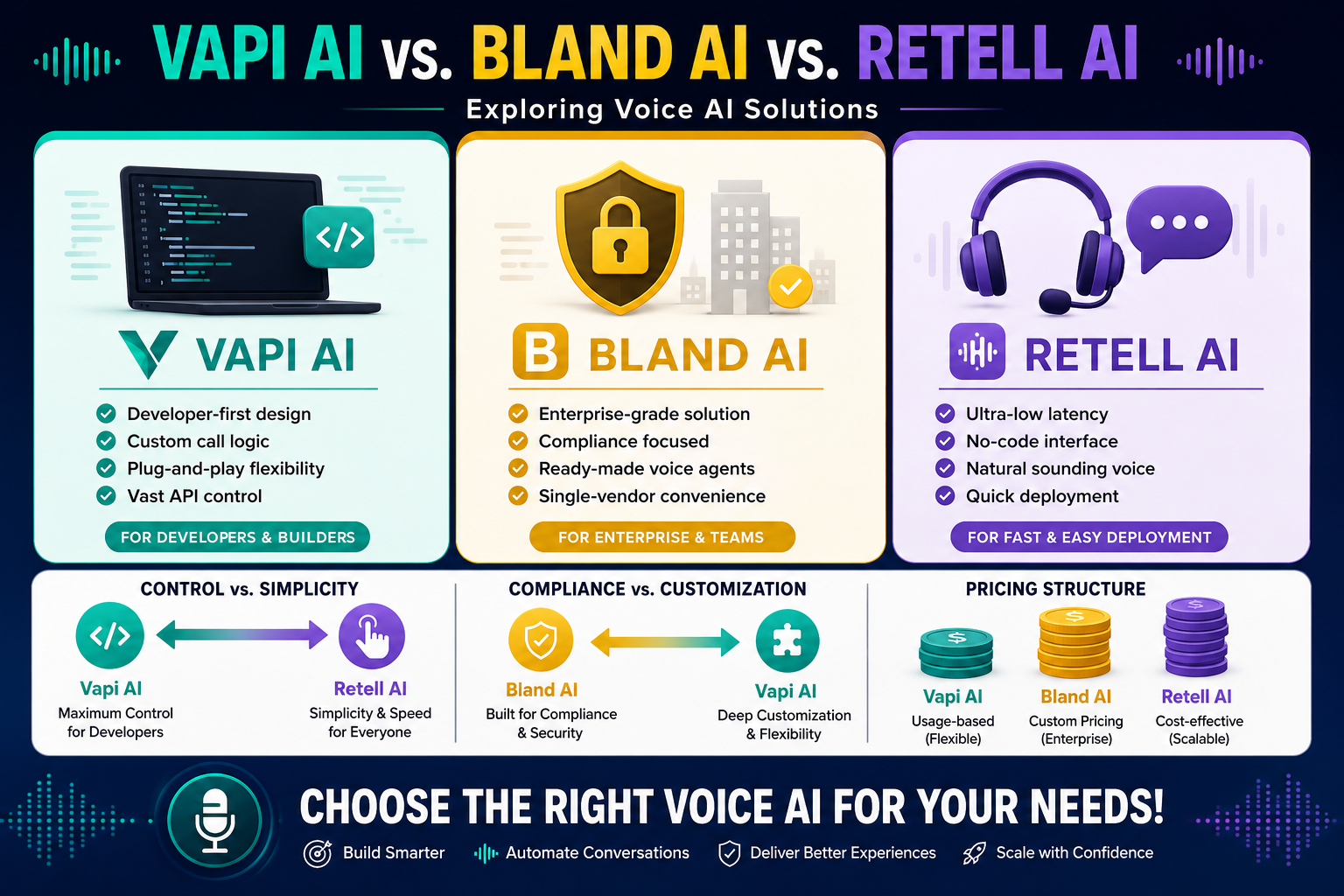
- The real choice is control vs simplicity, compliance burden, call quality out of the box, and who will run the system day to day.
Table of contents
Introduction
If you're shopping for a voice AI platform, you'll often get pitched three names that solve different problems. Vapi treats voice agents as programmable infrastructure: you choose STT, LLM, and TTS and build call logic like any other service. Bland bundles telephony, speech, and ops into a managed enterprise stack. Retell (included here because teams often compare it alongside Vapi and Bland) optimizes for fast setup, low latency, and voice realism in a no-code call center product.
Below: what each platform actually is, where it fits, and the tradeoffs that usually decide the purchase.
High-level positioning
For product and engineering leads, the useful split is:
- Vapi AI: orchestration layer for developers who mix models and own call logic.
- Bland AI: managed platform with an in-house speech and AI stack, aimed at compliance-heavy rollouts.
- Retell AI: voice-first call center product with a no-code builder and emphasis on latency and natural pacing.
That framing keeps you from comparing "flexibility" on one side with "time to first call" on another as if they were the same axis.
Vapi AI
Who it's for
Engineering teams assemble voice systems from parts here. You plug in different STT, LLM, and TTS providers, script flows, and connect to back-end systems. If your team already thinks in APIs and services, Vapi lets you treat voice agents as part of that stack. vapi.ai
How it works
Vapi runs a modular STT → LLM → TTS pipeline with streaming to cut choppiness. You get API hooks for call events, session and context management, and phone plus web channels. Teams tune latency, error handling, and conversational style per use case. Docs
Security and compliance
Vapi supports HIPAA and SOC 2 and offers private deployment (VPC or dedicated accounts). That covers most regulated setups; ISO 27001 is not called out in public docs, so verify if you need it. Docs
Pricing
Usage-based billing:
- $0.05/min for the orchestration layer
- STT, LLM, TTS, and telephony on top; realistic totals often land around $0.07–$0.25/min
- $10 trial credits (roughly 150–200 minutes)
- Many production deployments budget $40K–$70K/year
Strengths
- Bring-your-own models across the stack
- Full API and SDK access to call events
- Good fit when you want to own and iterate on voice infrastructure
Limitations
- Needs engineering time; not plug-and-play
- Phone-first; chat or messaging takes extra work
- Multi-provider flows add onboarding time
Bland AI
Who it's for
Enterprises that want one throat to choke for telephony, speech, and compliance paperwork. Bland targets teams that need production-ready voice agents without stitching vendors. Telephony, speech, and analytics live in one place, which simplifies audits and vendor management. bland.ai
How it works
Bland runs a proprietary STT, LLM, and TTS stack with pre-built connectors to common enterprise systems. Engagements often include professional services; rollouts commonly target ~30 days. Dashboards cover monitoring, analytics, and compliance reporting. Product info
Company profile
Founded in 2023, based in San Francisco, positioned for finance, healthcare, and other regulated sectors. About
Strengths
- Built around compliance and audit workflows
- Single vendor for voice, AI, and telephony
- Predictable go-live and enterprise support
Limitations
- Less room for deep API-driven customization
- Proprietary stack increases lock-in risk
- Pricing usually lives in enterprise negotiations, not public rate cards
Retell AI
Who it's for
Ops-led teams that need live calls fast, with natural voices and minimal code. Retell suits teams that want a no-code path to AI call centers with smooth turn-taking. Ops can build and tune agents without standing up heavy engineering integrations. retellai.com
How it works
Retell emphasizes low end-to-end latency (around 600 ms), voices trained on actor recordings, and models tuned for turn-taking. The platform includes telephony, prompts, analytics, and function calls for CRM and database hooks in real time. Docs
Typical use cases
Customer support, appointment scheduling, lead qualification, and guided tech support, especially when conversation flow and voice quality matter more than owning every model choice. No-code overview
Strengths
- Strong call quality and natural pacing out of the box
- No-code builder for non-engineering teams
- Built-in analytics for performance tracking
Limitations
- Logic and models run on Retell's pipeline; portability is limited
- Public security and compliance docs are thinner; confirm with sales for formal assurances
- Deep custom integrations are more constrained than on a developer-first platform
Direct comparison
Strategic focus
| Platform | Focus |
|---|---|
| Vapi AI | Programmable orchestration for developer teams |
| Bland AI | Managed enterprise stack for compliance and scale |
| Retell AI | Low-latency, no-code call center for operations |
Technology and flexibility
- Vapi: swap STT/LLM/TTS and control call logic through APIs.
- Bland: single-vendor stack; fewer low-level hooks.
- Retell: proprietary orchestration with a no-code flow builder and function calls.
Pricing and economics
- Vapi: $0.05/min orchestration plus provider costs (typical $0.07–$0.25/min).
- Bland: enterprise pricing with SLAs; details via sales.
- Retell: pricing leans on features and quality; public per-minute breakdowns are limited.
How to choose
Control vs simplicity: Choose Vapi if you have engineering capacity and want flexibility. Choose Retell for a fast no-code setup. Choose Bland if you prefer to offload compliance and day-to-day ops to one vendor.
Compliance: Bland is aimed at regulated sectors from the start. Vapi supports HIPAA and SOC 2 and can run in private environments. For Retell, ask sales for documentation if you need formal assurances.
Call experience: Retell's latency and voice models usually deliver the most natural pacing with the least tuning. Vapi can match that with the right provider mix and engineering time. Bland prioritizes stability and enterprise requirements over bespoke voice polish.
Operational ownership: Pick the platform that matches whether you want to own the stack or buy a managed service.
A simple way to think about it: Vapi is infrastructure, Bland is outsourced operations, Retell is a productized call center.
FAQ
Can Bland mix external providers like Vapi?
No. Bland uses its own stack. You cannot swap in external STT, LLM, or TTS.
Does Retell support HIPAA-compliant calls?
Retell leads with call quality and speed. Confirm HIPAA or SOC 2 support directly with sales.
How long does it take to integrate Vapi?
Basic voice agents can be live in a few days. Complex multi-provider flows often take weeks.
Are there free trials?
Vapi offers $10 in trial credits. Bland trials are usually enterprise proofs of concept through sales. Retell offers demos and may run pilots.
Which platform is best for outbound telemarketing?
Custom dialing and complex logic: Vapi. Quick, compliant enterprise rollouts: Bland. Realistic, no-code campaigns: Retell.
3 curated tools below.
Bland AI
Bland AI is a managed voice agent platform for inbound and outbound phone calls. Unlike orchestration-only tools, Bland bundles STT, LLM, TTS, and telephony into one per-minute rate on self-serve plans (vendor claim). It targets regulated enterprises wanting compliant, production phone agents with pathways, automations, and CRM integrations without assembling five vendors.
Retell AI
Retell AI is a developer-focused platform for building, deploying, and scaling real-time AI voice and chat agents for customer service, sales, and operations. It bundles speech-to-text, LLM orchestration, text-to-speech, telephony, and analytics into one API-first stack with no mandatory platform subscription.
Vapi AI
Vapi is a developer-first voice AI platform for building and deploying conversational voice agents at scale. It provides orchestration, real-time monitoring, and configuration tools that let engineering teams assemble custom voice stacks using their own LLM, TTS, STT, and telephony providers. It targets enterprise use, supports millions of calls with sub-500ms latency, and offers SOC 2, HIPAA, and PCI compliance.