Review
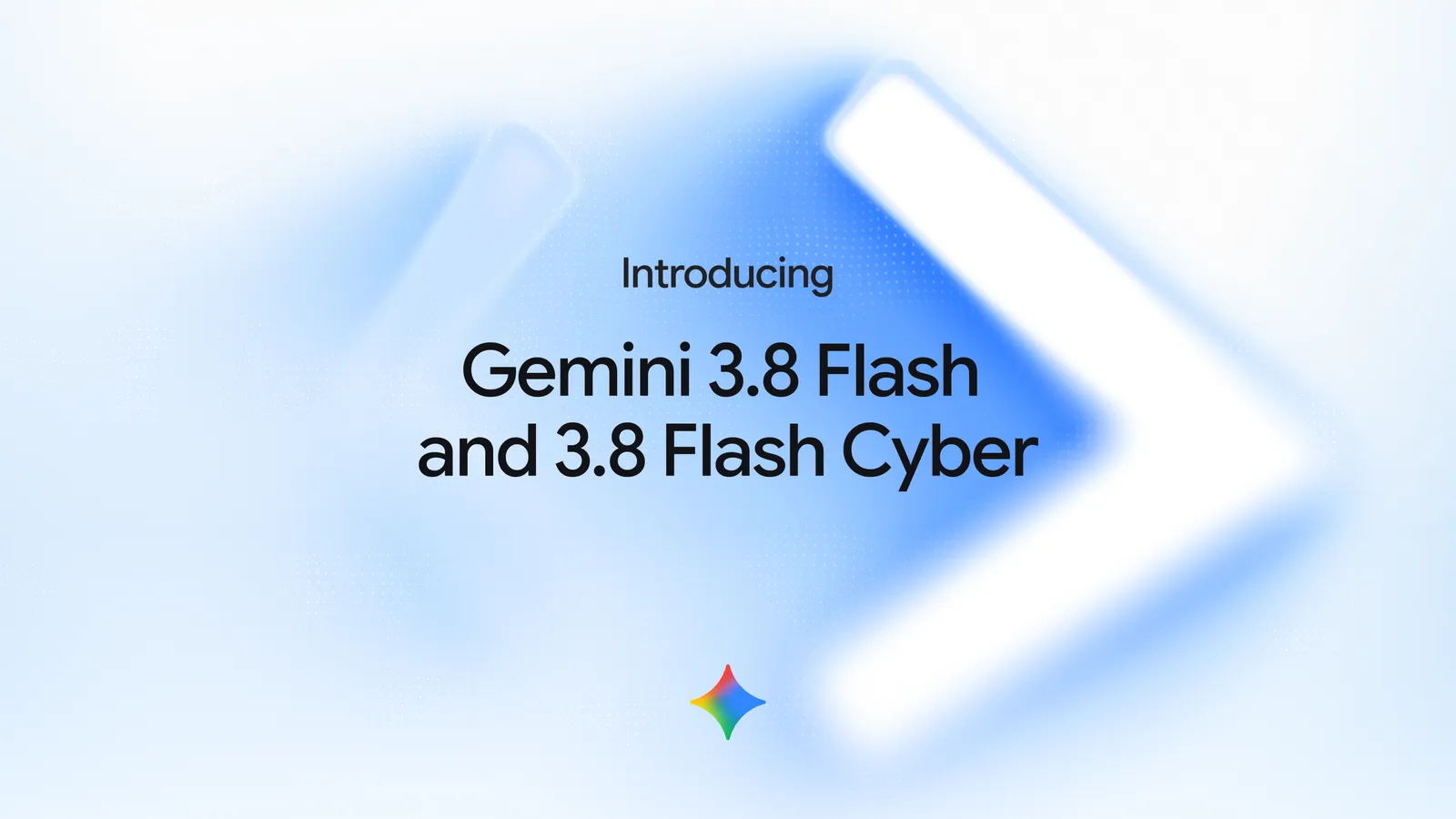
Gemini 3.8 Flash review: pricing, Cyber, and who should switch
Key takeaways
- Gemini 3.8 Flash launched September 2, 2026, three weeks after 3.7 Flash. Google’s third Flash drop in about six weeks.
- Positioned as Google’s best reasoning and coding Flash yet, at the same intro price as 3.7: $0.75 / 1M input and $3.75 / 1M output through December 31, 2026, then $1.50 / $7.50.
- Twin: Gemini 3.8 Flash Cyber for vulnerability discovery and patching, gated via the new Fairwind Program (trusted defenders / gov / critical infra).
- Available in Gemini API, AI Studio, Antigravity, Gemini Enterprise, and for Google AI Pro / Ultra in the Gemini app, AI Mode, and Sheets.
- Vendor benches favor long-horizon SWE and specialized agents. Treat Google’s charts as vendor harnesses, not independent audits.
- Pick 3.8 when agent diligence matters. Keep 3.7 (still supported) when you want fewer tokens and lower effort by default.
Table of contents
- What shipped
- Pricing and access
- What Google claims improved
- Flash vs Flash Cyber
- Who should switch
- FAQ
What shipped
Google did not ship a new Gemini Pro on September 2. It shipped another Flash iteration, and it is leaning hard into that cadence.
For practitioners:
Gemini 3.8 Flash is Google’s workhorse multimodal model for coding, agentic loops, and multi-step reasoning, priced like 3.7 Flash during the intro window. Gemini 3.8 Flash Cyber is the same foundation with cyber-focused capabilities, limited to Fairwind partners.
That separates:
- Gemini product surface: app, AI Mode, Sheets, Enterprise.
- 3.8 Flash (GA workhorse): API + Studio + Antigravity + consumer Pro/Ultra.
- 3.8 Flash Cyber (gated): Fairwind only. Not a public toggle for “better coding.”
Knowledge cutoff framing (model card / coverage): March 2026 for some domains; others may still feel closer to January 2025. Confirm against the live model card before you rely on recent facts.
Pricing and access
Verified September 2026 against Google’s announcement.
| Gemini 3.8 Flash | Gemini 3.8 Flash Cyber | |
|---|---|---|
| Role | GA workhorse Flash | Cyberdefense specialist |
| API intro (through Dec 31, 2026) | $0.75 in / $3.75 out per 1M tokens | Fairwind program pricing / access |
| API after Jan 1, 2027 | $1.50 in / $7.50 out | Program-dependent |
| Developer surfaces | Gemini API, AI Studio, Antigravity, Android Studio, Stitch | Fairwind partners |
| Consumer | Google AI Pro / Ultra (Gemini app, AI Mode, Sheets) | Not a consumer SKU |
| Enterprise | Gemini Enterprise | Fairwind for trusted defenders |
Introductory pricing is the story. If your agents burn a lot of tokens, the Dec 31 cliff matters more than the marketing charts.
What Google claims improved
From Google’s post (vendor numbers):
- Strong showing on DeepSWE v1.1 long-horizon software engineering versus many larger frontier models at Flash cost.
- Gains on specialized agent benches such as Vals Finance Agent V2 and Harvey Legal Agent Benchmark versus 3.7 Flash.
- HLE-Verified 54.9% cited for multi-step reasoning across STEM and professional fields.
- Design note: 3.8 “works harder” (more reasoning steps and tool calls on complex tasks). Lower effort settings or staying on 3.7 remain options when token burn is the constraint.
- Safety: CBRN and cyber-offense safeguards on standard Flash; Cyber is more permissive for defensive cyber and therefore gated. Prompt-injection robustness gains claimed via Gray Swan measurements.
Demo narratives lean Antigravity builds (games, DOS Maps, USGS topo, Three.js teardowns). Fun for marketing; not a substitute for your repo evals.
Flash vs Flash Cyber
| 3.8 Flash | 3.8 Flash Cyber | |
|---|---|---|
| Audience | Builders and Pro/Ultra users | Trusted defenders via Fairwind |
| Focus | Coding, agents, general multi-step work | Vulnerability discovery + automated patching |
| Safeguards | Standard Flash / Frontier Safety Framework | More permissive cyber mitigations |
| Public access | Yes | Application / vetting |
Google cites CyberGym frontier-level discovery, >70% on an internal multi-language vuln bench, CWE-Bench pass@1 about 47.2% near a larger frontier model at higher cost, Chrome Security 2.6× more correct patches than best commercial models tested, and partner notes from Wiz and Cloud Vuln Research. Again: vendor and partner claims.
Who should switch
Move to 3.8 Flash when:
- You already like Gemini Flash economics and want better long-horizon coding agents.
- You live in Antigravity / AI Studio and want the newest workhorse.
- You are comparing Flash-class cost to Claude Opus/Fable or ChatGPT frontier SKUs and need a cheaper agent loop.
Stay on 3.7 (or lower effort) when:
- Token burn and latency dominate, and 3.8’s “works harder” behavior hurts unit economics.
- Your evals do not move on your real tasks.
Apply to Fairwind when: you are a defender org that needs Cyber’s vuln/patch loop. Everyone else should ignore Cyber marketing as a public upgrade path.
Also compare the same-day Meta drop: Muse Spark 1.3 review and Gemini 3.8 Flash vs Muse Spark 1.3.
5 curated tools below.

ChatGPT
ChatGPT is OpenAI's flagship conversational AI on web, mobile, and desktop. It covers writing, coding, research, image/video, voice, and agentic work. As of late 2026, paid Work and Codex surfaces expose the GPT-6 family (including GPT-6.1 Sol), while Pro/Business Premium users in eligible markets get OpenAI Dots: always-on agents with their own cloud computer.

Claude
Claude is Anthropic's AI assistant for nuanced writing, long-context reasoning, and coding via Claude Code. The Claude 5.5 family (including Sonnet 5.5, launched September 28, 2026) is the current default for fast, cost-efficient professional and coding work on claude.ai and the Claude API.

Cursor Ai
Cursor is an AI-native code editor (VS Code fork) for software developers. Agent mode plans and edits across your repo with frontier models (GPT, Claude, Gemini, and others). Tab completions stay unlimited on paid plans; agent and premium model use is metered. Use Cursor when you want full-repo context inside the editor. Prefer GitHub Copilot when PR review and GitHub-native seats matter more. Many teams run both.

DeepSeek
DeepSeek is a Chinese AI lab whose current flagship models, DeepSeek-V4-Flash and DeepSeek-V4-Pro, compete with GPT-5 and Claude-class models on coding, reasoning, and general tasks at a fraction of the API cost. The free chat interface at chat.deepseek.com offers both models (Flash as "Instant Mode," Pro as "Expert Mode"), while the API provides OpenAI- and Anthropic-compatible endpoints for developers. Both models are open-weight under an MIT license and available for self-hosting via Hugging Face.
Gemini
Gemini is Google's multimodal AI assistant and model family across the Gemini app, AI Mode in Search, AI Studio, and the Gemini API. As of October 2026 the frontier flagship is Gemini 4 Argon (paid API / Pro+Ultra surfaces); Flash-class models remain the cheaper workhorse for high-volume agents.
| Tool | Best for | Pricing | Billing note |
|---|---|---|---|
| ChatGPT | AI chatbot / general-purpose assistant | Freemium | Free Trial |
| Claude | AI chatbot / reasoning & coding assistant | Freemium | Free Trial |
| Cursor Ai | Code | Freemium | Free Trial |
| DeepSeek | Code Assistant | Freemium | Free Trial |
| Gemini | Productivity | Freemium | Free Trial |
Frequently asked questions
Is Gemini 3.8 Flash better than Gemini 3.7 Flash?
Google says yes on coding, agents, and specialized reasoning, at the same intro price. Confirm on your harness and tasks. 3.7 stays supported for efficiency-first workloads.
How much does Gemini 3.8 Flash cost?
API intro through Dec 31, 2026: $0.75 / $3.75 per 1M input/output tokens. From Jan 1, 2027: $1.50 / $7.50. Consumer access is via Google AI Pro or Ultra seats, not a separate Flash SKU.
What is Gemini 3.8 Flash Cyber?
A cybersecurity-tuned variant for vulnerability discovery and patching, available through Google’s Fairwind Program to trusted defenders, not as a general consumer model.
Does this replace Gemini Pro?
No. This is another Flash release. Larger Pro-class Gemini updates remain a separate product story.