How-to guide
How to set up an AI agent for SMEs (insurance and beyond)
Estimated reading time: 14 minutes. Last verified: September 2026.
Key takeaways
- For SMEs, an "AI agent" should mean a supervised worker that completes one business workflow end to end, not a chat box bolted onto the website.
- Start with one high-volume, rule-heavy process (renewals, booking, lead follow-up, invoice chase). Do not start with "make the company AI-native."
- Buy a vertical or workflow product when the job is regulated or channel-heavy. Build with general agents or automation when the job is internal and your stack is simple.
- Insurance, property, clinics, hospitality, professional services, and B2B sales all fit, but the first workflow and compliance bar differ by industry.
- Success looks like a 30 to 60 day pilot with named owners, written handoff rules, and one metric (containment, cycle time, or booked meetings), not a permanent chatbot experiment.
Table of contents
- What an AI agent means for an SME
- When to set one up (and when not to)
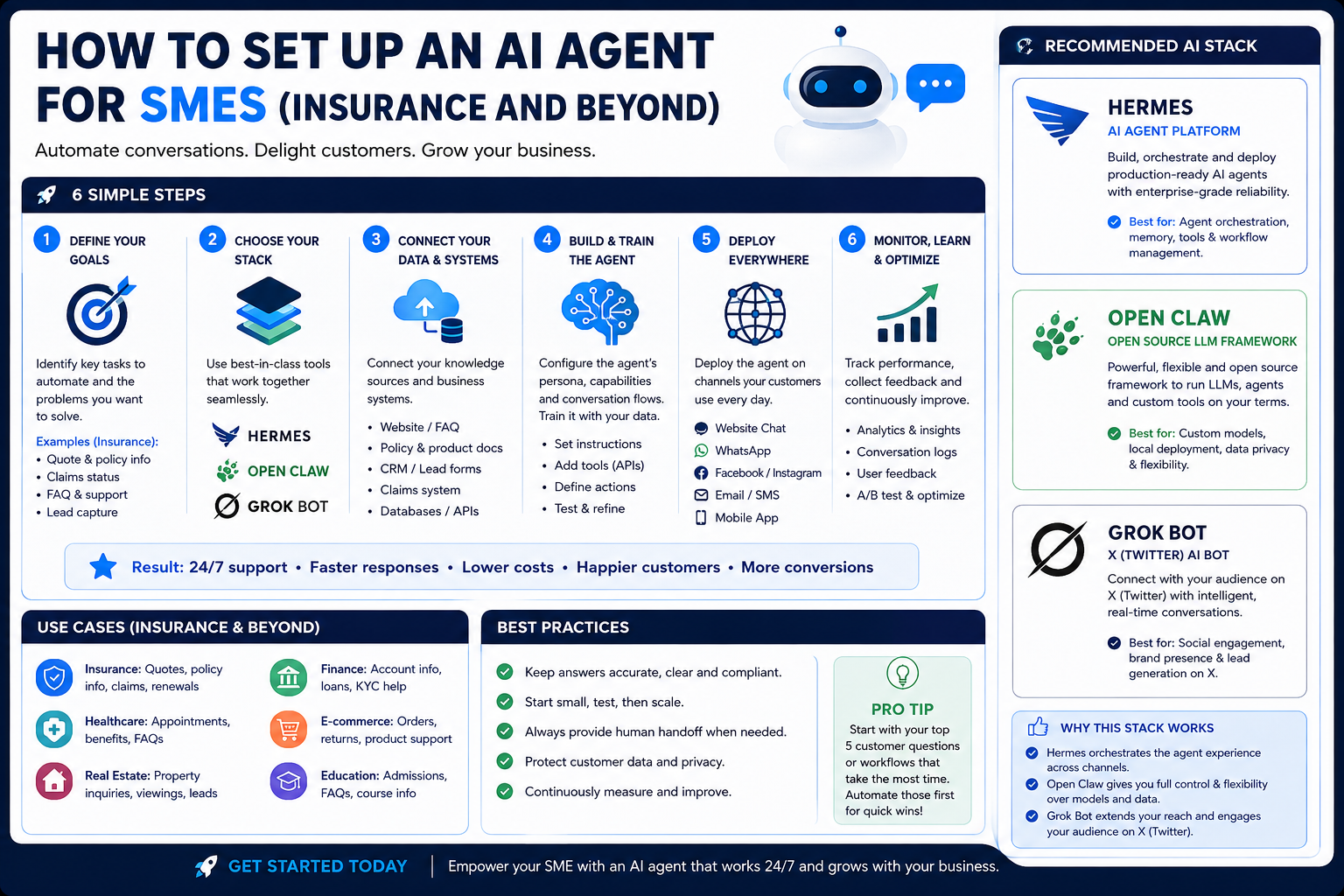
- The setup playbook (7 steps)
- Industry starting points
- What to buy vs build
- Pilot scorecard
- Common failure modes
- Related tools
- FAQ
What an AI agent means for an SME
The phrase is overloaded. For a small organisation, the useful definition is the simplest one:
An AI agent is software that takes a business goal, uses approved tools and data, and finishes the job (or hands off) without a human driving every step.
That definition separates four things people lump together:
- Chat assistant: answers questions in a box (ChatGPT, Claude). Useful for staff, rarely enough for ops by itself.
- Website chatbot: FAQs and lead capture on your site (Dante AI, SiteGPT). Good front door, weak back office.
- Workflow automation: deterministic "if this, then that" (Gumloop-style stacks). Reliable for fixed paths; brittle when language or judgment shows up.
- Agent: can research, decide within policy, call systems, and keep going until done or blocked (Solid, Claude Cowork, vertical products like EliseAI or fonio).
A simple way to think about it: automation follows a script; an agent follows a brief with guardrails.
What that means in practice for an SME:
- What it is: one owned workflow with tools, policies, and a human escape hatch.
- What keeps it supervised: approvals, spend/access limits, audit logs, and clear "never do this alone" rules.
- What it is not: a magic employee you deploy once and ignore, or a replacement for regulated judgment on day one.
When to set one up (and when not to)
Set one up when:
- The same process happens dozens or hundreds of times a month.
- The inputs are messy (email, calls, WhatsApp, forms) but the outcomes are clear (booked appointment, paid invoice, updated CRM).
- Staff already follow a checklist you could write on one page.
- Someone will own the pilot (ops lead, office manager, or founder), not "IT eventually."
Wait when:
- You cannot name the first workflow in one sentence.
- The process requires licensed advice with no human review (especially insurance advice, medical diagnosis, legal counsel).
- Your CRM, calendar, or phone stack is in total chaos and nobody can map fields.
- Leadership wants "an AI strategy" but will not pick a metric or a budget.
If you are still deciding between chat and agents for personal productivity, see the shortlist in Best AI personal assistants in 2026. This guide is about organisation workflows, not your personal inbox.
The setup playbook (7 steps)
How to set up an AI agent for an SME in practice:
1. Pick one workflow, not a platform
Write a one-line brief: "When X happens, the agent should do Y, and escalate when Z."
Examples that work for small orgs:
- New web lead → qualify → book a call → update CRM
- Missed call / WhatsApp → answer FAQs → schedule → hand off to staff
- Invoice overdue → reminder sequence → log promise to pay → escalate disputes
- Policy renewal window → collect missing docs → schedule broker call → update case file
- Support ticket stuck → gather history → propose resolution → ask human to approve
If you cannot fill X / Y / Z, you are not ready to buy software.
2. Map systems and data the agent may touch
List every system in the path: CRM, email, calendar, phone/WhatsApp, helpdesk, accounting, document store, claims or policy admin.
For each system note:
- Read vs write access
- Who owns credentials
- What fields must never be invented (policy numbers, premiums, medical details, bank data)
No map, no agent. Agents fail loudest on missing write-back, not on model quality.
3. Write the policy before the prompt
Before you open any vendor, write:
- Allowed actions (book meetings, send templates, create tickets)
- Forbidden actions (promise coverage, change bank details, waive fees without approval)
- Handoff rules (dispute, hardship, legal threat, "I want a human," confidence below threshold)
- Tone and identity (who the agent claims to be; when it discloses it is AI)
- Retention (call recording, chat logs, deletion)
This document becomes the product requirements. Vendors that cannot express these rules in the product are the wrong vendors.
4. Choose the shape: vertical product, general agent, or hybrid
| Shape | Best when | Examples on this directory | Watch out for |
|---|---|---|---|
| Vertical / channel product | Regulated or high-volume voice, SMS, WhatsApp, leasing, collections | fonio, EliseAI, Skit.ai, Callbook AI | Sales cycles, integration work, less flexible outside the niche |
| General business agent OS | Cross-tool GTM and ops jobs with approvals | Solid | Pricing often sales-led; needs clear budgets and permissions |
| Knowledge-work agent | Internal research, docs, sheets, light connectors | Claude Cowork, ChatGPT agent features | Weak on phone channels and industry compliance out of the box |
| Coding / ticket agent | Software teams or digital product orgs | Devlo, Tempo, AutonomyAI | Wrong tool for insurance CX; right for product SMEs |
| Sales Autopilot | Outbound research and meeting booking | Explee, Jason AI, Artisan | Deliverability and compliance risk if unsupervised |
| Site chatbot | Front-door FAQ and lead capture | Dante AI, SiteGPT | Not a full agent unless wired to backend actions |
Most SMEs should buy the shape that matches the channel, then use a general assistant for staff side work.
5. Wire identity, access, and a sandbox
Minimum safe setup:
- Dedicated agent identity (email / phone / WhatsApp number), not a founder's personal inbox.
- Least-privilege API keys and a separate CRM user role where possible.
- Sandbox or pilot book of business (one branch, one product line, one region).
- Human review queue that someone actually checks daily.
- Kill switch: who can pause the agent in under five minutes.
For voice and WhatsApp, confirm quiet hours, consent, and recording rules for your country before go-live. EU SMEs using fonio-style phone/WhatsApp plans still need local compliance review; US collections-style deployments need FDCPA/TCPA-aware products like Skit.ai, not a generic chatbot.
6. Run a 30 to 60 day pilot with one owner
Pilot design that works in small orgs:
- Owner: named person, not a committee
- Volume: enough traffic to learn (rough rule: at least a few dozen real cases per week)
- Success metric: pick one primary (see scorecard below)
- Review cadence: weekly 30-minute review of failures and handoffs
- Exit criteria: keep, expand, or kill; decide on a calendar date
Vendor pilots that only use demo scripts are marketing. Insist on live traffic with your templates and escalation rules.
7. Measure, then either expand or stop
Expand only after the agent beats the baseline on the primary metric without creating a new backlog of messy escalations. If humans spend more time fixing agent mistakes than they saved, kill the workflow and pick a narrower one.
Industry starting points
These are first workflows that fit SMEs and small organisations. They are starting points, not full digital transformations.
Insurance brokers and MGAs
First agent job: renewal and document chase, or inbound FAQ + appointment booking for brokers.
Why it fits: high volume, checklist-heavy, lots of "did you send the form?" work that burns junior staff.
Rules that must stay human: coverage advice, binding, claims decisions, anything that looks like regulated advice in your jurisdiction.
Tool shape: WhatsApp/phone assistant for booking and FAQs (fonio); knowledge-work agent for internal file prep (Claude Cowork); avoid unsupervised outbound that invents policy terms.
Not ideal for day one: full claims adjudication.
Property management and leasing
First agent job: tour booking, resident FAQs, maintenance intake.
Vertical products exist for a reason. EliseAI is built for leasing and resident ops across messaging and voice. A generic chatbot rarely matches that depth.
Not ideal for day one: rent collection disputes without clear policy and human approval.
Clinics and local healthcare admin (non-clinical)
First agent job: appointment scheduling, reminders, intake form chase.
Keep clinical advice and triage out of the agent unless you have clinical governance and a product designed for it. Treat the agent as front-desk automation with strict handoff.
Channels: phone and WhatsApp matter more than a website widget for many clinics.
Hospitality and local retail
First agent job: reservations, opening hours, menu/FAQ, order status.
High ROI when staff are interrupted all day by the same questions. Pair a phone/WhatsApp assistant with calendar or POS integrations.
Not ideal for day one: complaint refunds without manager approval.
Professional services (law, accounting, consultancies)
First agent job: new enquiry qualification and meeting booking; internal research/drafting for staff.
Public-facing agents should never give legal or tax advice. Use them to collect facts, book consults, and prepare packs for humans.
Internal agents (Claude Cowork, ChatGPT) help with drafts and research if your confidentiality rules allow the vendor.
B2B sales-led SMEs
First agent job: research ICP accounts, draft personalised outreach, book demos.
Products like Explee, Jason AI, and Artisan sit in this lane. Start with a small list and human approval on sends until reply quality is proven.
Not ideal for day one: fully unsupervised cold email at scale on your primary domain.
Collections and receivables (fintech, agencies, utilities)
First agent job: early-stage reminders and promise-to-pay capture with compliance checks.
This is a specialised category. Skit.ai and Callbook AI are collections-oriented; a generic SDR tool is the wrong shape.
Software and digital product SMEs
First agent job: tickets to PRs, PR review, or PM-to-PR delivery on a real repo.
Use Devlo, Tempo, or AutonomyAI when engineering is the bottleneck. This is a different buyer journey from insurance CX; do not force one product to cover both.
Cross-industry ops (content, LinkedIn, support recovery)
Always-on workers that span tools (research, draft, update CRM, open PRs) fit agent OS products like Solid. Useful when your "job" is outcome-shaped ("publish weekly founder posts from Slack notes") rather than channel-shaped ("answer WhatsApp").
What to buy vs build
| Situation | Prefer | Why |
|---|---|---|
| Phone / WhatsApp / SMS heavy | Buy vertical or channel product | Telephony, consent, and concurrency are hard to DIY well |
| One internal doc/research workflow | Use Cowork / ChatGPT agent | Fastest path; low integration cost |
| Many SaaS tools, outcome briefs | Agent OS or automation + LLM | Needs connectors, budgets, approvals |
| Unique niche process, strong in-house IT | Hybrid: automation platform + LLM | You own the process map |
| Regulated collections or leasing at scale | Vertical specialist | Compliance and playbooks are the product |
A useful rule: if the hard part is the channel and the rules, buy. If the hard part is your weird internal process, assemble with a general agent plus automation, and keep the scope tiny.
Pricing changes often. Treat figures on tool pages as dated snapshots (verify live checkout). Examples from September 2026 directory research: fonio publishes EUR WhatsApp and phone ladders; Devlo lists credit plans from about $19/mo; Solid and Skit.ai are largely sales-led. Confirm before you budget.
Pilot scorecard
Track weekly. One primary metric is enough.
| Metric | What good looks like | Notes |
|---|---|---|
| Containment / automation rate | Rising without rising complaints | Share of cases finished without human |
| Handoff quality | Humans get full context, not "please help" | Bad handoffs erase savings |
| Cycle time | Faster booking, renewal, or resolution | Compare to pre-pilot baseline |
| Error / rework rate | Flat or down | Include wrong bookings and invented facts |
| Cost per completed outcome | Down or stable with better volume | Include vendor fees + human review time |
| Staff trust | Team wants to keep it | Soft signal; still decisive in SMEs |
Kill criteria examples: invented facts about prices or coverage; quiet-hour violations; more than X% of cases needing full human redo.
Common failure modes
- Chatbot theatre. A website widget that cannot book, write to CRM, or escalate cleanly. Looks modern; changes nothing.
- Too many workflows. Three agents, zero owners. Pick one.
- No write-back. Agent "helps" in chat while the CRM stays empty. Staff still retype everything.
- Prompt without policy. Clever instructions, no forbidden-action list. Fine until the first angry customer.
- Wrong category buy. Buying a coding agent for insurance CX, or a collections platform for a five-person consultancy.
- Pilot on fake data. Passes demos; fails on real accents, real objections, real edge cases.
- No kill switch. Nobody knows how to pause the number or revoke the API key on a Friday night.
Related tools
- Solid — always-on agent OS across GTM and ops
- fonio — WhatsApp and phone assistants (EUR plans)
- EliseAI — leasing and resident conversational ops
- Skit.ai — regulated collections voice AI
- Claude Cowork — managed knowledge-work agent
- Explee — AutoGTM outbound agents
- Devlo — tickets to PRs for product teams
- Dante AI / SiteGPT — site chat front doors
10 curated tools below.

ChatGPT
ChatGPT is OpenAI's flagship conversational AI on web, mobile, and desktop. It covers writing, coding, research, image/video, voice, and agentic work. As of late 2026, paid Work and Codex surfaces expose the GPT-6 family (including GPT-6.1 Sol), while Pro/Business Premium users in eligible markets get OpenAI Dots: always-on agents with their own cloud computer.

Claude Cowork
Claude Cowork is Anthropic's agentic product for non-coding knowledge work: you hand it a goal and it works across folders, connectors, and tools to deliver finished drafts for review. It is distinct from Claude Chat and from Claude Code (engineering-focused).
Dante AI
Dante AI is a no-code platform for building website AI agents and chatbots trained on your site content, docs, and files. It emphasizes a flat monthly plan (not per-resolution ticket fees), multi-model replies billed in credits, Zapier-style integrations, and publish-to-site workflows for support and lead capture.

Devlo
Devlo is an AI software platform for building and editing apps in the browser, converting tickets to PRs, reviewing code, running custom agents, and measuring team AI productivity.

EliseAI
EliseAI is an enterprise agentic AI platform that automates leasing, resident, and patient communications across text, email, chat, and voice for multifamily and single-family housing operators and healthcare providers. It centralizes workflows in EliseCRM and covers prospecting through maintenance, renewals, and delinquency.
Explee
Explee runs AutoGTM AI agents that research markets, find ICP prospects, write personalized email, and book meetings, plus AI Search over a large company/people database.
fonio
fonio is a Vienna-based AI call and WhatsApp assistant platform for appointment booking, inbound/outbound phone, and chat automation with human handover.
Sitegpt
SiteGPT lets businesses deploy a ChatGPT-style assistant trained on their website, docs, and files to answer visitor questions accurately in brand voice. No-code setup supports sitemap crawling, PDF uploads, Notion/Google Drive connectors, embed widgets, and escalations to human support tools like Zendesk.

Skit.ai
Skit.ai is an AI collections and customer-operations platform that runs omni-channel voice, SMS, email, and chat agents with compliance controls for banks, agencies, fintechs, and healthcare portfolios.
Solid
Solid is an agent operating system that runs always-on AI workers across GTM, support, and engineering workflows with approved access to machines, accounts, phone numbers, and spend budgets.
| Tool | Best for | Pricing | Billing note |
|---|---|---|---|
| ChatGPT | AI chatbot / general-purpose assistant | Freemium | Free Trial |
| Claude Cowork | AI Agent | Paid | Paid Service |
| Dante AI | AI Chatbot Builder | Freemium | Free Trial |
| Devlo | Code Assistant | Paid | Paid Service |
| EliseAI | Healthcare | Paid | Paid Service |
| Explee | AI B2B lead generation / AutoGTM | Freemium | Free Trial |
| fonio | AI phone and WhatsApp assistants | Freemium | Free Trial |
| Sitegpt | AI Website Chatbot & Customer Support | Freemium | Free Trial |
| Skit.ai | Text To Speech | Freemium | Free Trial |
| Solid | AI agent operating system / always-on workers | Freemium | Free Trial |
Frequently asked questions
How do I set up an AI agent for a small business?
Pick one workflow with a clear trigger and outcome, map the systems it must read and write, write allowed and forbidden actions, choose a vertical product or general agent that matches the channel, run a 30 to 60 day pilot on real traffic with one owner, and keep or kill based on a single primary metric.
What is the best first AI agent for an insurance SME?
Start with renewal document chase or inbound FAQ plus appointment booking, not claims decisions or coverage advice. Use a phone/WhatsApp assistant for customer channels and a knowledge-work agent for internal prep, with a human required for regulated advice.
Do SMEs need developers to deploy an AI agent?
Not for many channel and vertical products. You do need someone who can own CRM fields, calendar permissions, and weekly review. Custom agents across many internal systems may need light IT or a partner.
AI agent vs chatbot for SMEs: which should we buy first?
Buy a chatbot if you only need website FAQ and lead capture. Buy an agent when the job must finish in another system (book, update CRM, chase documents, place a call) with handoff rules. Many orgs run a thin chatbot in front and an agent behind.
How much does an SME AI agent cost?
Wide range. Self-serve assistants and builders can start around low tens of dollars per month plus usage. Phone/WhatsApp plans are often priced in conversation or minute bundles (for example [fonio](/tool/fonio) EUR tiers as of September 2026). Vertical enterprise products for collections or leasing are usually quote-based with pilots. Budget for human review time, not only the subscription.
How long until we see results?
Useful signal in two to four weeks if you have real volume. A fair keep/kill decision usually needs 30 to 60 days. Instant ROI claims without a baseline are marketing.
What industries benefit most from SME AI agents?
Any industry with repetitive, checklist-heavy customer or admin work: insurance brokerage, property management, clinics (admin), hospitality, professional services intake, B2B outbound, receivables, and software delivery ops. The industry matters less than whether you can name one workflow and own the pilot.