Review
Fish Audio Review (2026): Voice Cloning, Pricing, and Safety
Estimated reading time: 8 minutes. Last verified: August 21, 2026.
Key takeaways
- Fish Audio covers text-to-speech, voice cloning, multilingual speech, speech-to-text, audio separation, and sound effects in one platform.
- You can use it in a web app, mobile app, REST API, or SDK. Creators and developers both have a path in.
- Models include S1, S2, and S2-Pro (open-weight Fish Speech family). You can use the hosted product or self-host if your team has the infra.
- Voice cloning is fast: some flows work from ~10–15 seconds of sample audio, with output that holds up in blind tests against pricier tools.
- Emotion tags, pacing, pauses, and word-level control let you shape delivery without re-recording.
- Common buyers: creators, businesses, game devs, and support teams building voice agents.
- Independent comparisons often rank Fish Audio high on quality, latency, and price per character relative to ElevenLabs-class alternatives.
Table of contents
- What Fish Audio is
- Core capabilities
- Models and technology
- Voices, languages, and scale
- Platform, apps, and developer workflows
- Pricing and plans
- Typical use cases
- Independent reviews
- Company background
- Ethical and legal considerations
- Related tools on 101aitools
- FAQ
Fish Audio turns text (or a short voice sample) into speech and audio assets you can ship. The pitch is simple: AI voices that sound human enough for YouTube, games, and customer support, without booking studio time.
What it actually does:
- Text-to-speech (TTS)
- Voice cloning
- Multilingual speech and dubbing
- Speech-to-text (ASR)
- Audio separation and sound effects
Browser, mobile app, REST API, SDK. No-code creators and engineers can both get value from the same stack. See the full listing on 101aitools for pricing and category context alongside other voice tools.
What Fish Audio is
At the core, Fish Audio converts text or a voice sample into natural speech with minimal setup. The usual buyers: creators, marketers, editors, product teams, developers, and ops teams rolling out voice features.
Three ways people use it:
- Web app: paste text, pick a voice, generate, download
- REST API and SDKs: embed TTS, streaming, ASR, and cloning in your product
- Mobile app: same workflow on iPhone/iPad when you're away from a desk
Why teams pick it over a single-purpose TTS API:
- Multiple audio tools in one place (TTS, cloning, ASR, separation, effects)
- Built on open-weight Fish Speech models, with a commercial layer at fish.audio
- Fits narration, dubbing, game dialogue, and live voice agents
Useful starting points:
Core capabilities of Fish Audio
This is not "type text, get MP3." The product is built around expressive speech, fast cloning, and enough control that you can fix a line without regenerating the whole clip.
Text-to-speech
High-fidelity output for voiceovers, ads, podcasts, audiobooks, and game dialogue. Generation is fast, and streaming works for near real-time use cases (support bots, interactive apps).
Voice cloning
Synthetic voices from short samples. Some models work from ~10 seconds; the marketing site cites ~15 seconds for instant clone. Useful when you need one brand voice, one game character, or one narrator across languages.
Emotion and style control
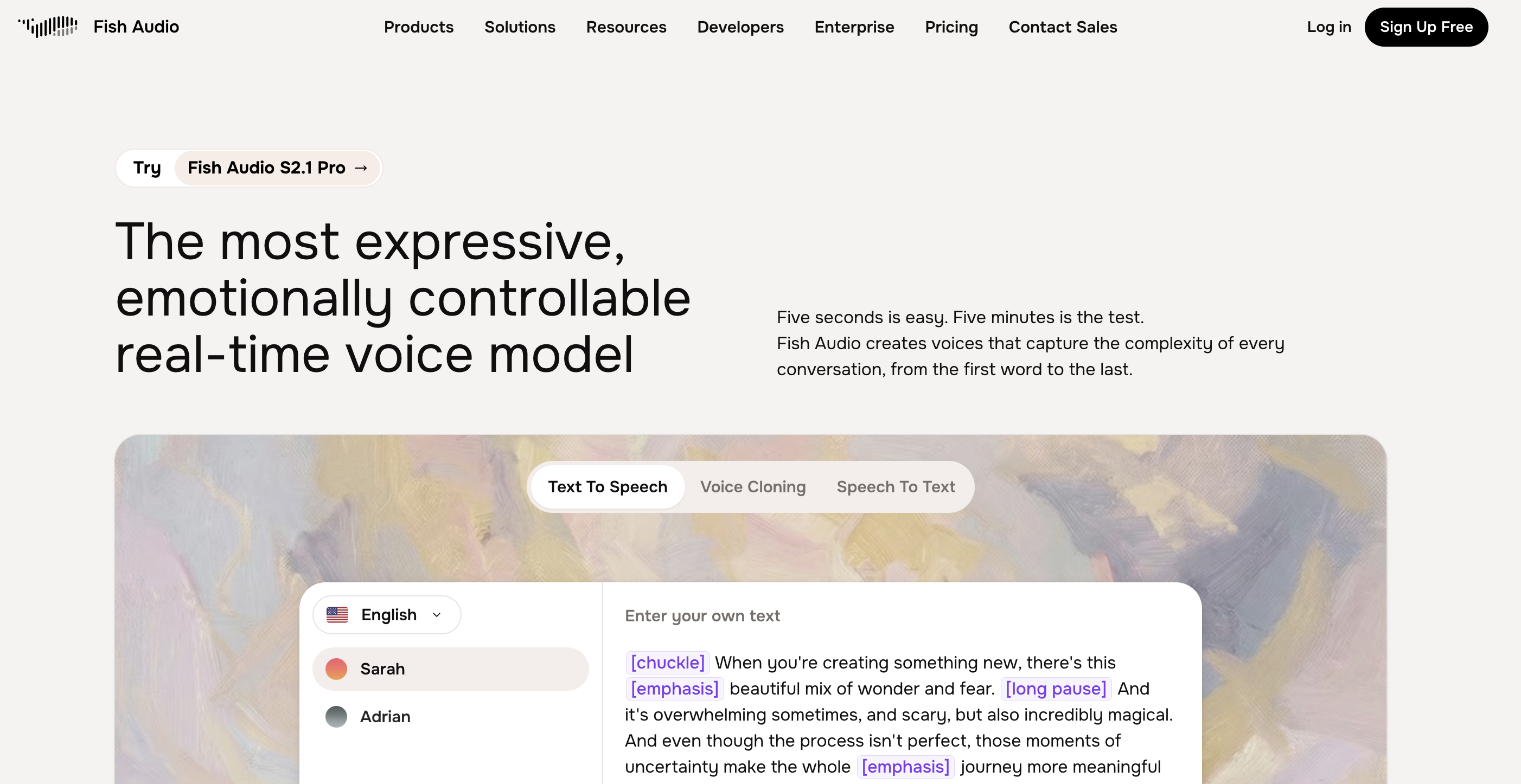
Inline tags adjust tone (calm, excited, whisper, laugh), pacing, and pauses. S2 adds word-level control: tag a single word or phrase to change prosody without touching the rest of the sentence. That matters when a script has one emphasized word or a dramatic pause mid-line. Noiz AI takes a similar emoji-tag approach if you want a second opinion on emotion-driven TTS.
Multilingual speech
Broad language coverage (often cited as 80+ languages). Cross-lingual cloning keeps the same voice identity when you localize: clone in English, generate in Japanese or Spanish with the same "speaker."
Other audio tools
ASR, audio separation (vocals vs instruments), voice changing, and sound-effect generation. Handy if your pipeline is "transcribe, separate, regenerate" rather than TTS-only.
Further reading:
Models and technology behind Fish Audio
Fish Audio runs on the Fish Speech model family: S1, S2, and S2-Pro.
S1
Early commercial model. Established the baseline for expressive TTS and emotional delivery.
S2 / S2-Pro
S2 improved realism, multilingual quality, cloning, and control. S2-Pro is the higher tier: more stable long-form output and stronger expressiveness. S2.1 Pro is the current flagship on the consumer site.
Word-level control
Tag individual words or phrases to change prosody, pause, speed, or emotion. Less "regenerate until it sounds right," more surgical edits.
Open weights and self-hosting
Teams with GPU infra can self-host available weights for privacy, cost at scale, or custom pipelines. Most teams still use the hosted API because billing and ops are simpler.
Latency and streaming
Built for low-latency streaming. Useful for live assistants and anything where time-to-first-audio matters. Sub-second startup is commonly reported; your mileage depends on text length, model, and region.
Docs: Models overview and pricing
Voices, languages, and scale in Fish Audio
Voice scale
The platform hosts a large community voice library (2M+ voices cited on site). Directories sometimes inflate that into "millions of configurations." In practice: lots of preset voices plus cloning, so you're not stuck with the same 20 stock narrators.
Languages
English, Japanese, Korean, Chinese, French, German, Arabic, Spanish, and many others. Exact count varies by source (30+ on API comparisons, 80+ on marketing). Check the model docs for your target locale before you commit.
Cross-lingual cloning
Clone once, generate in another language. Important for localization teams that want one character voice across regions without re-hiring voice talent per market.
Why scale matters
Faster iteration, consistent brand or character voice, and less "we need a new recording session for every script change."
References:
Platform, apps, and developer workflows
Web app
Paste text, choose voice, add emotion/pacing tags, generate, download. Straightforward for creators who don't want to touch an API.
Mobile app
iOS app supports TTS, cloning, and multi-speaker scripts.
Developer tools
REST API plus SDKs (Python, TypeScript/Node.js). Embed TTS, streaming, ASR, and cloning in apps, games, and internal tools.
Typical engineering use cases:
- Streaming TTS in a consumer app
- ASR + TTS pipelines
- Multilingual dubbing automation
- Voice agents and game dialogue systems
Docs: Developers
Pricing and plans for Fish Audio
Tiers change; confirm at fish.audio/plan before you budget.
Consumer / creator plans (July 2026)
| Plan | Price | What you get (high level) |
|---|---|---|
| Free | $0/mo | ~8,000 credits (~7 min/mo), 500 chars/generation, personal use per FAQ |
| Plus | $15/mo ($5.50/mo annual) | ~250K credits (~200 min), 1 professional clone slot, commercial use |
| Pro | $100/mo ($37.50/mo annual) | ~2M credits (~1,620 min), 3 team seats, 5 pro clone slots |
| Max | $999/mo ($749/mo annual) | ~25M credits, 10 seats, 15 pro clone slots |
Credits reset monthly. Unused minutes don't roll over.
API pricing (pay-as-you-go)
- TTS (S2-Pro, S2.1-Pro, S1): $15 per million UTF-8 bytes (~180K English words, ~12 hours of speech)
- ASR (transcribe-1): $0.36 per audio hour
- Voice design: $0.01 per successful request
That API rate is often 5–10x cheaper per character than premium competitors like ElevenLabs, which is why dev teams evaluate Fish Audio early. For a lower-commitment consumer option in the same price range, see Play.ht or Speechify.
Self-hosting
Open weights can cut API spend or keep data on-prem. You pay in engineering time and GPU cost instead.
Questions before you buy
- How many minutes per month?
- Do you need commercial rights? (Free tier is personal-only per FAQ.)
- API only, web only, or both?
- How many clone slots do you need?
Reference: Models and pricing docs
Typical use cases and target users
Creators
YouTube voiceovers, short-form video, podcast clips, narration, character voices. Good when you revise scripts often and don't want to re-record every time.
Audiobooks
Long-form narration with consistent voice and fast revisions. S2-Pro is aimed at hours-long output; still test a chapter before you commit to a full book.
Game development
NPC dialogue, character voices, interactive speech, localization. Emotion tags help when one line needs to land differently than the rest of the scene.
Businesses
Ads, explainers, support bots, training, voice agents. API pricing makes high-volume use cases more viable than with some subscription-only TTS vendors like Murf AI.
Accessibility and localization
Translated audio, screen-reader-friendly content, local-language versions with the same cloned voice.
Why teams switch from studio-only workflows: faster turnaround, reusable voice identity, lower marginal cost per minute. Weaker when you need a specific human celebrity voice with legal clearance, or broadcast union requirements.
Sample writeups:
Independent reviews and voice AI comparison
Reviewers tend to agree on a few points:
- Voice quality sounds natural in blind tests, especially S2/S2-Pro
- Emotion and style control is above average for the price
- Generation and streaming are fast enough for production use
- Price-performance is strong vs ElevenLabs on API metering
- Feature set goes beyond basic TTS (ASR, separation, effects)
How it compares
Often mentioned next to ElevenLabs and OpenAI voice products. Fish Audio's edge in comparisons: realistic cloning, low latency, open-weight option, and API cost. ElevenLabs still wins some English-only quality tests; Fish Audio often wins on cost and control tags. Resemble is worth a look too if deepfake detection and voice security matter alongside generation.
Common themes in reviews: realism, speed, and dollars per million characters.
Company background and ecosystem
Fish Audio's commercial product sits on top of the Fish Speech open-weight work. Operated by Hanabi AI Inc. (founded 2024). The company announced a $52M seed and cites 8M+ builders on the homepage.
Open releases and a Discord community mean more tutorials, third-party integrations, and a real self-host path. You're not locked into only the hosted API if your team can run models themselves.
References:
Ethical and legal considerations
Voice cloning is useful and easy to misuse. Treat it like any powerful impersonation tool.
Consent
Get clear permission before cloning a real person's voice. Written consent is the minimum for anything commercial or public.
Deepfake risk
High-quality clones can fuel fraud and impersonation. Don't build deceptive apps. Platform terms matter; so do local laws.
Licensing
Free plan: personal, non-commercial per FAQ. Paid plans: commercial use on verified/cloned voices you own. Read terms before you monetize YouTube or client work.
Reasonable uses
Accessibility, localization, creative production, reducing studio cost for teams with rights to the source voice.
Bad uses
Scams, impersonation, non-consensual clones.
Simple rule: if it's a real person's voice, get consent in writing first.
Relevant pages:
Related tools on 101aitools
If Fish Audio isn't quite the fit, these voice AI tools are also listed on 101aitools:
- Fish Audio — the tool covered in this review; full listing with pricing and category tags
- Noiz AI — emoji-driven emotion control, 3-second voice cloning, and built-in video dubbing
- ElevenLabs — premium voice quality and cloning, often the benchmark in blind tests
- Murf AI — studio-style TTS built for business and e-learning voiceovers
- Play.ht — large voice and language library with commercial licensing on paid tiers
- Resemble — voice cloning paired with deepfake detection for security-conscious teams
- Speechify — consumer-focused TTS and reading assistant for accessibility use cases
Safety in practice
Fish Audio is safe as a vendor when you treat voice cloning like any biometric-adjacent capability: get consent, disclose synthetic speech where required, and keep commercial use inside their plan terms. The free tier FAQ restricts some commercial use; check the live plan page before you ship.
7 curated tools below.

Eleven Labs
ElevenLabs is a leading AI audio platform for realistic text-to-speech, voice cloning, speech-to-text, dubbing, sound effects, music generation, and conversational AI agents (ElevenAgents). It serves creators, developers, publishers, and enterprises with a unified credit system across products. Known for high-quality voice synthesis, multilingual support, and low-latency API used in apps, audiobooks, games, and customer service bots.
Fish.audio
Fish Audio is a legitimate AI TTS and voice-cloning platform (not a scam site). It is safe when you have consent to clone a voice and stay inside their plan terms. Free and paid web plans plus a developer API undercut many ElevenLabs rates per character.
Murf AI
AI voiceover and text-to-speech platform with 200+ voices across 20+ languages. Studio for content creation plus separate Falcon API for developers needing low-latency TTS.
Noiz.ai
Noiz AI is an AI audio studio for emotional text-to-speech, rapid voice cloning, voice design from text or images, and multilingual video dubbing with lip sync. Its V2 Emotion Pro model supports emoji-based emotion control, SSML, and a 200+ voice library for creators producing podcasts, audiobooks, and localized video content.
Play.ht
Play.ht is an AI voice generation platform that converts text to natural-sounding speech across hundreds of voices and languages. It supports voice cloning, commercial licensing, API access, and podcast-style audio production. The product serves creators, marketers, and developers who need scalable TTS without recording talent.
Resemble
Resemble AI is an enterprise generative AI security platform combining voice cloning, text-to-speech, and multimodal deepfake detection for audio, image, and video. Pivoted from consumer voice tools toward security infrastructure with Detect, Intelligence, Identity, and Watermarker products.
Speechify
Speechify reads text aloud with natural AI voices across web, PDFs, docs, and mobile—plus voice typing, AI summaries, and a Voice AI Assistant. Celebrity voice options and 60+ languages target accessibility, productivity, and consumer listening use cases.
| Tool | Best for | Pricing | Billing note |
|---|---|---|---|
| Eleven Labs | Text To Video | Freemium | Free Trial |
| Fish.audio | Text To Speech | Freemium | Free Trial |
| Murf AI | Voice To Text | Freemium | Free Trial |
| Noiz.ai | Text To Speech | Freemium | Free Trial |
| Play.ht | Voice To Text | Freemium | Free Trial |
| Resemble | Voice AI / Deepfake Detection | Freemium | Free Trial |
| Speechify | Text To Speech | Freemium | Free Trial |
Frequently asked questions
What is Fish Audio?
Fish Audio is an AI voice platform for expressive text-to-speech, instant voice cloning, speech-to-text, and related audio tools, available via web app, mobile, REST API, and SDK.
Is Fish Audio safe to use?
Yes when you follow consent and licensing rules. Do not clone a voice without permission. Fish Audio is a legitimate hosted TTS/cloning vendor; safety depends on how you use clones (consent, disclosure, and local law), not on whether the site itself is a scam. Review their terms and keep API keys private.
Is Fish Audio free?
There is a free web plan with limited monthly credits. Paid Plus and API usage unlock higher volume. Confirm current credit amounts on fish.audio/plan before buying.
Does Fish Audio support voice cloning?
Yes. Instant cloning is a core feature, with emotion tags and long-form narration on newer models such as S2 / S2-Pro.
How does Fish Audio compare to ElevenLabs?
Fish Audio usually wins on API cost per character. ElevenLabs usually wins on studio tooling and dubbing workflows. See Fish Audio vs ElevenLabs for a full breakdown.
Can developers integrate Fish Audio?
Yes via REST API and SDKs. Latency and streaming options make it usable for agents and apps, not only batch narration.