Guide
Best AI Coding Assistants for Developers in 2026
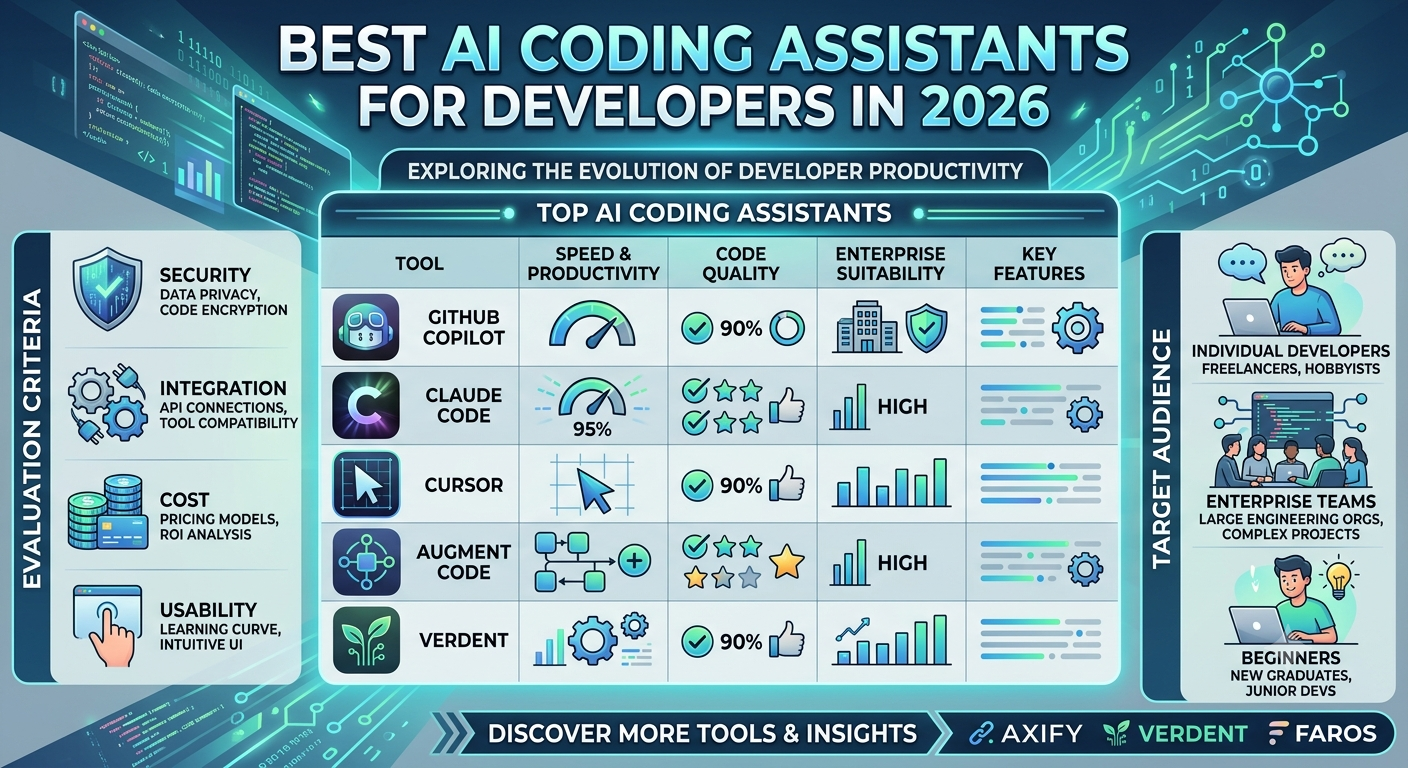
Best overall mainstream choice: GitHub Copilot
For most individual developers and mainstream teams in 2026, GitHub Copilot is still the safest default. What people actually get from it:
- Inline code completions and chat help inside the editor
- Support across major IDEs, so you can adopt it without changing your workflow
- A controlled study found developers finished tasks about 55% faster with Copilot
- Teams of five or more often report it "pays for itself" within the first month, based on accepted suggestion rates
It handles a wide range of languages and frameworks with little setup. Pricing starts around $10/month, with a free option for students. It fits best for:
- General-purpose coding in standard IDEs
- Mixed-language projects and mainstream frameworks
- Teams that want faster output without changing how they work
More on GitHub Copilot: Netguru.
Best for deep reasoning and complex debugging: Claude Code
Claude Code is the pick when the hard part is thinking through the code, not just generating the next line. It is especially useful for:
- Debugging complex logic and tangled code paths
- Multi-file refactors and repository-level changes, not just line-by-line edits
Ranked with GitHub Copilot and Cursor in many 2026 roundups, it is strongest for reasoning-heavy work. Use it when you need help with:
- Subtle bugs and complex business logic
- Multi-file refactors and architectural changes
- Conversational problem-solving with code
More on Claude Code: Faros.
Best AI-first editor and repo-wide work: Cursor
Cursor is built as an AI-first editor, not a plugin bolted onto an existing IDE. The main differences:
- Multi-file refactors and repo-level edits through AI-driven workflows
- About a 35-40% score on SWE-bench-style benchmarks for resolving real GitHub issues
That only pays off if you are willing to switch editors. It fits:
- Developers open to an AI-centric editor
- Large refactors, multi-file changes, and pattern-based edits
- Teams experimenting with agent-like workflows inside the editor
More on Cursor: Verdent.ai.
ChipAgents — best for chip design and hardware verification teams
ChipAgents doesn't compete with the general-purpose tools already on this page; it's a domain-specialized agent for semiconductor RTL design and verification (Verilog/SystemVerilog generation, automated testbenches, waveform-log root-cause analysis). No public pricing, sold via demo request and scoped to team size and design complexity. Add as its own entry: "Best for hardware/chip design teams," explicitly noting it's not a fit for general software work. See our full ChipAgents vs Cursor comparison for more on when a specialized tool like this beats a general coding assistant.
Windsurf (now Devin Desktop) — best for managing multiple concurrent AI agents
Add as "Best agent-orchestration editor," reflecting the June 2, 2026 rebrand to Devin Desktop under Cognition. Free → $20/month Pro → $200/month Max → $80/month + $40/user Team → custom Enterprise. Its differentiator versus everything else on the list: an Agent Command Center as the default interface and Agent Client Protocol support for running third-party agents (including Codex) inside the same editor. Full detail in Cursor vs Windsurf.
Google Stitch — best free option for turning designs into working UI code
Google's free Gemini-powered Labs experiment ("Google Stitch," listed in our DB as google-stich-ai) generates UI designs and frontend code from text descriptions or uploaded images/wireframes, with export to Figma and React. Add as "Best free design-to-code tool," positioned as a complement to a coding assistant rather than a replacement, since it produces UI scaffolding, not full application logic.
21st.dev — best component registry for AI coding agents
Correcting a data quality issue found during this research: 21st.dev is not a machine-learning platform (our existing DB description is wrong and needs a separate fix). It's a registry of 12,000+ React components, templates, and shadcn-compatible themes, each shippable as a copy-paste "AI-ready prompt" that drops straight into Cursor, Claude Code, v0, or Lovable. Free to browse with 2 free copies/day; membership unlocks unlimited copies and AI credits. Add as "Best component library for AI-assisted frontend work."
Floot — best all-in-one builder for non-developers
Floot bundles frontend, backend, database, auth, and hosting into one AI app builder aimed at non-technical founders rather than professional developers. Free forever (3,000 AI credits) → Pro $25/month → Enterprise (custom, $20k/year minimum). Add with a clear caveat: this belongs on the page as "Best no-code option for non-developers," not as a peer to Cursor or Copilot, since the audience barely overlaps.
Best for a specialized niche: ChipAgents, and best for agent orchestration: Devin Desktop (formerly Windsurf)
Not every team needs a general-purpose assistant. If your work is semiconductor RTL design and verification, ChipAgents is purpose-built for that domain in a way none of the general tools above are, though it's sold enterprise-only with no public pricing.
If you're managing several AI coding agents at once rather than writing most code yourself, Devin Desktop (the product formerly known as Windsurf, rebranded June 2026) is built around exactly that: an Agent Command Center for tracking every local and cloud agent session, with support for running other vendors' agents (including OpenAI's Codex) inside it via the Agent Client Protocol.
For turning a design into working frontend code before you even open a coding assistant, Google Stitch (free) and 21st.dev (a component registry, not a generator) both feed directly into Cursor, Copilot, or Claude Code once you're ready to wire up logic. And if you're not a developer at all, Floot bundles the entire stack, frontend to hosting, so there's nothing separate to configure.
10 curated tools below.

21st.dev
21st.dev is an AI platform that helps developers and teams build and deploy machine learning models faster. It sits in the machine learning tools category and works for both beginners and more experienced data practitioners. Its main appeal is that it reduces the time needed to go from data to a working model

Claude
Claude is Anthropic's AI assistant for nuanced writing, long-context reasoning, and coding via Claude Code. The Claude 5.5 family (including Sonnet 5.5, launched September 28, 2026) is the current default for fast, cost-efficient professional and coding work on claude.ai and the Claude API.

Codeium
Codeium began as a free AI autocomplete extension and evolved into Windsurf, a full AI-native code editor (VS Code–derived). In 2025–2026 Cognition acquired Windsurf and rebranded it as Devin Desktop alongside the Devin cloud agent. codeium.com and windsurf.com redirect to devin.ai/pricing. Core value: agentic multi-file editing, unlimited Tab completions, and cloud agent sessions.

Cursor Ai
Cursor is an AI-native code editor (VS Code fork) for software developers. Agent mode plans and edits across your repo with frontier models (GPT, Claude, Gemini, and others). Tab completions stay unlimited on paid plans; agent and premium model use is metered. Use Cursor when you want full-repo context inside the editor. Prefer GitHub Copilot when PR review and GitHub-native seats matter more. Many teams run both.

Floot
Floot is an AI-powered no-code application development platform that enables entrepreneurs, startups, and non-technical users to build, deploy, and scale production ready web applications using natural language prompts. Unlike many AI coding tools, Floot includes the entire technology stack frontend, backend, database, authentication, hosting, and deployment within a single platform, eliminating the need for external developer tools.

Github Copilot
GitHub Copilot is GitHub's AI pair programmer that provides code completions, chat, agents, code review, and CLI assistance inside IDEs and GitHub.com. As of June 2026 it uses GitHub AI Credits for usage-based billing across chat, agent mode, cloud agents, and code review. It supports multiple models including Claude, GPT, and Gemini variants depending on plan.
Google Antigravity Ai
Google Antigravity is Google's agent-first development platform combining an AI-powered IDE, a standalone agent command center (Antigravity 2.0), CLI, and SDK. It supports autonomous agents that plan and execute multi-step software tasks with browser control, subagents, scheduled tasks, and artifacts. Built on Gemini models with optional Claude and GPT model access.

Kimi Ai
Kimi is Moonshot AI's conversational assistant and agent platform, known for long-context reasoning, multi-step agent workflows, and the Kimi K3 flagship model launched July 2026. It offers chat, Agent Swarm, Kimi Claw browser automation, and Kimi Code for developers—all distinct from the Moonshot API used by third-party apps.
OpenAI Codex
OpenAI Codex is the company's agentic coding product — not the deprecated 2021 code-completion API, but a modern cloud and local coding agent included with ChatGPT paid plans. It ships as the Codex app (macOS/Windows), CLI, IDE extensions, and cloud sandbox tasks on connected GitHub repos. Users queue multi-step engineering work and review results asynchronously.
Windsurf
Windsurf is an AI-powered code editor (a VS Code fork) developed by Codeium. Its headline feature is Cascade, an AI agent that handles multi-file editing, planning, code generation, and terminal command execution. Positioned as a lower-cost alternative to Cursor, Windsurf offers unlimited autocomplete on the free tier and a flat $20/month Pro plan (vs. Cursor's variable pricing that can reach $35–60/month for heavy users).
| Tool | Best for | Pricing | Billing note |
|---|---|---|---|
| 21st.dev | Code | Freemium | Free Trial |
| Claude | AI chatbot / reasoning & coding assistant | Freemium | Free Trial |
| Codeium | Code Assistant | Freemium | Free Trial |
| Cursor Ai | Code | Freemium | Free Trial |
| Floot | Code | Freemium | Free Trial |
| Github Copilot | Code Assistant | Freemium | Free Trial |
| Google Antigravity Ai | Agentic Development Platform / AI IDE | Freemium | Free Trial |
| Kimi Ai | AI Agent | Freemium | Free Trial |
| OpenAI Codex | Code | Freemium | Free Trial |
| Windsurf | Code Assistant | Freemium | Free Trial |