Comparison
AI harness vs agent: what is the difference?
Key takeaways
- Agent = the working system people use (model + harness + config + permissions).
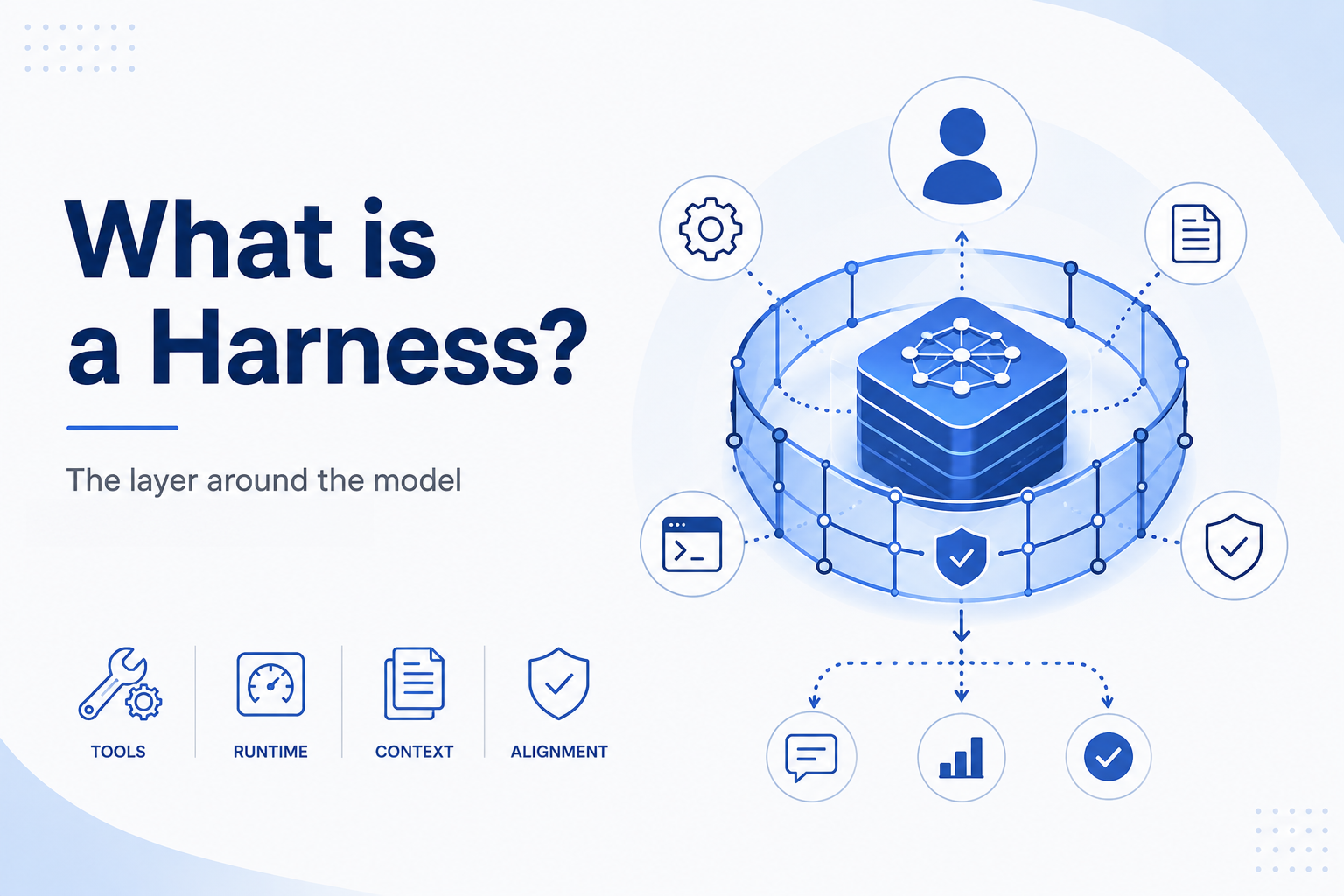
- Harness = the infrastructure layer inside that system.
- Saying "we built an agent" usually means you configured a harness around a model for a job.
- "AI harness" in search queries almost always means agent harness, not a separate third category.
Table of contents
The split that matters
| Term | Means | Example |
|---|---|---|
| Model | LLM that predicts tokens | Claude, GPT, Grok, local weights |
| Harness | Runtime around the model | Loop, tools, memory, sandbox, gates |
| Agent | Model + harness + job config | "Invoice triage Bot on Grok Bot" |
| Product | Packaged agent experience | Claude Cowork, Hermes app |
People say "agent" when they mean the whole thing. Engineers say "harness" when they mean everything that is not the weights.
What that means in practice:
- What an agent is: a configured system that can pursue a goal with tools.
- What keeps it supervised: the harness's permissions, approvals, and stop rules.
- What it is not: the model card alone, or a protocol like MCP.
Examples
- ChatGPT agent mode: you interact with an agent product. Underneath is OpenAI's harness (browser/tools/loop) plus a GPT model.
- Hermes: the open-source harness is the product. You bring models.
- OpenClaw: gateway-first harness; the "agent" is whatever profile and tools you run on it.
- Grok Bot: each named Bot is an agent instance on SpaceXAI's managed harness.
- Claude Cowork: managed agent for knowledge work; Anthropic owns the harness.
Related: Agent harness vs MCP, What is an agent harness.
Hermes (also called Hermes Agent) is Nous Research's open-source, self-improving AI agent you can run on desktop, terminal, or cloud. It keeps persistent memory across sessions, builds skills from completed work, and connects to messaging surfaces like Telegram, Discord, Slack, WhatsApp, Signal, and email. Distinct from the Hermes LLM model family name alone.
Best for
Developers and power users who want a self-hostable, model-agnostic agent with persistent memory and messaging integrations
Pros
Truly free to install and fork (MIT) Persistent memory and skill growth across sessions Model-flexible (local or many cloud models) Messaging plus desktop plus cloud surfaces in one agent
Cons
Real cost is opaque until you pick models, tools, and hosting Self-host setup is heavier than consumer chat apps Portal Tool Gateway and paid models sit behind subscription credits Enterprise SSO and admin polish lag managed SaaS agents

Hermes
Hermes (also called Hermes Agent) is Nous Research's open-source, self-improving AI agent you can run on desktop, terminal, or cloud. It keeps persistent memory across sessions, builds skills from completed work, and connects to messaging surfaces like Telegram, Discord, Slack, WhatsApp, Signal, and email. Distinct from the Hermes LLM model family name alone.
ChatGPT is OpenAI's flagship conversational AI on web, mobile, and desktop. It covers writing, coding, research, image/video, voice, and agentic work. As of late 2026, paid Work and Codex surfaces expose the GPT-6 family (including GPT-6.1 Sol), while Pro/Business Premium users in eligible markets get OpenAI Dots: always-on agents with their own cloud computer.
Best for
General users who want the broadest AI feature set in one subscription, Developers using Codex alongside chat (Plus/Pro), Small teams needing SSO and admin without Enterprise sales, Content creators needing text, image, and video in one place, Power users who hit free limits and need frontier models
Pros
Widest feature set: chat, code, research, image, video, voice, agents Large plugin/GPT ecosystem and 60+ app connectors on Business Plus at $20/mo has held price while capabilities expanded Strong brand trust and frequent model upgrades Team plans with SSO at accessible per-seat pricing
Cons
Free tier is heavily rate-limited vs paid Deep Research and agent usage caps frustrate heavy researchers Privacy: consumer data may train models unless opted out Pro tiers ($100–$200) only worth it for power users hitting Plus limits Can be verbose or confidently wrong on niche factual queries

ChatGPT
ChatGPT is OpenAI's flagship conversational AI on web, mobile, and desktop. It covers writing, coding, research, image/video, voice, and agentic work. As of late 2026, paid Work and Codex surfaces expose the GPT-6 family (including GPT-6.1 Sol), while Pro/Business Premium users in eligible markets get OpenAI Dots: always-on agents with their own cloud computer.
Frequently asked questions
Is an AI harness the same as an AI agent?
No. The harness is the runtime. The agent is the runtime plus model plus configuration for a job. In casual speech people blur them.
Can I have a harness without an agent?
Yes. Idle infrastructure. You have an agent once you assign a goal, tools, and identity.
Can I have an agent without a harness?
Not in the modern sense. A bare chat completion API call is not an agent. Thin "agent" marketing sometimes fakes it with one tool call.