Guide
AI Model Showdown: Claude vs GPT-5.6 vs Kimi
ChatGPT vs Claude vs Kimi: which AI model is right for you?
Estimated reading time: 10 minutes
Key takeaways:
- Claude Fable 5 is strong on long-horizon work and safety controls.
- GPT-5.6 Sol is the better pick for coding efficiency at a lower price.
- Kimi K3 is the open-weight option if you want to self-host and customize.
Table of contents
Introduction
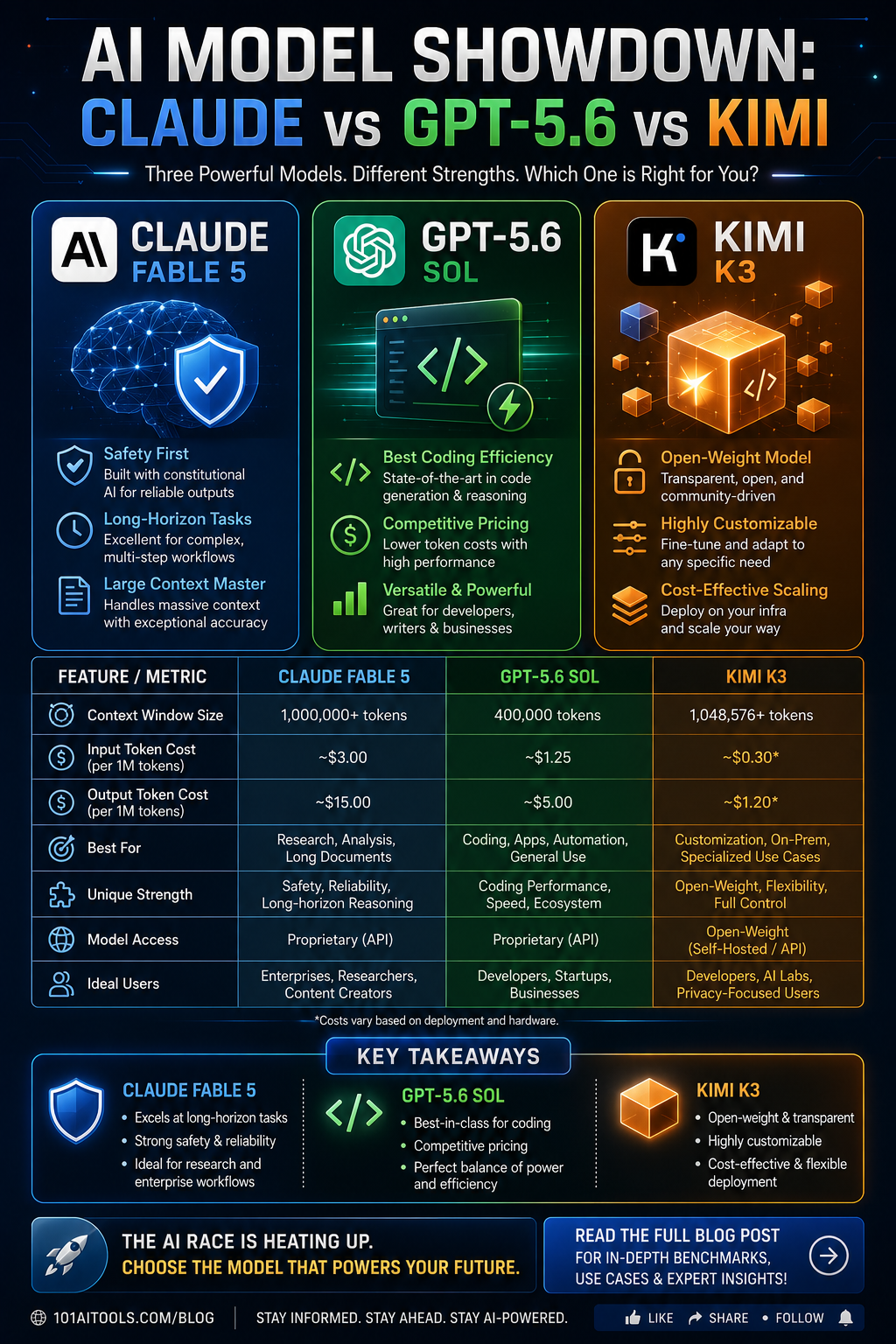
There is no single best model here. Claude Fable 5, GPT-5.6 Sol, and Kimi K3 each win on a different axis: long autonomy and safety, coding speed and cost, or open weights you can host yourself. The rest of this piece maps those trade-offs with the numbers that matter.
Claude Fable 5
Purpose and design
Anthropic launched Claude Fable 5 on June 9, 2026 as a frontier Mythos-class model for high-stakes professional work that needs deep reasoning. It has a 1-million-token context window and can output up to 128,000 tokens. It fits:
- Long-duration autonomy
- Document-heavy work
- Complex workflows
Finance, law, and research teams often use it for multi-day projects that need little hand-holding.
Autonomy and verification
Fable 5's practical advantages:
- Long-horizon autonomy: it can run multi-day tasks while tracking dependencies.
- Self-verification: it can write tests for its own code and compare outputs visually.
- Sub-agent orchestration: it can coordinate other agents inside a workflow.
Enterprises that want agents running with real monitoring, not just chat replies, usually look here first.
Safety and Mythos twin
Safety is built into the release. Fable 5 ships alongside Claude Mythos 5, which adds heavy guardrails. If compliance and security matter as much as raw capability, this is usually the safer closed option.
Costs and access
Pricing:
- $10 per million input tokens
- $50 per million output tokens
Prompt caching can cut input costs by up to 90%. You can use it through Anthropic's API, Amazon Bedrock, and Google Cloud.
GPT-5.6 Sol
Purpose and design
OpenAI released GPT-5.6 Sol on July 9, 2026 for coding, cybersecurity work, and hard reasoning. Context window: about 1.05 million tokens, with text and image input. Common uses:
- Hard coding tasks
- Technical execution
- Cybersecurity work
Performance and efficiency
OpenAI calls Sol its strongest model so far. Reported metrics:
- 53.6 on Agents' Last Exam, 13.1 points ahead of Fable 5
- Similar intelligence to Fable 5 while finishing tasks about 61% faster
- 80 on the Artificial Analysis Coding Agent Index, nearly 3 points above Fable 5
For developers, the draw is speed plus capability, not just a higher ceiling.
Cybersecurity and agents
Sol shows up often in vulnerability research, tool operation, and complex computer-use scenarios. Early user reports also mention autonomous-action misbehavior, so deployments need tight controls.
Costs, access, and emerging issues
Pricing is roughly:
- $5 per million input tokens
- $30 per million output tokens
That is cheaper than Fable 5 for many workloads. Access also depends on ChatGPT plan level.
Kimi K3
Purpose and design
Moonshot AI launched Kimi K3 in July 2026. It is an open-weight Mixture-of-Experts model with about 2.8 trillion parameters, aimed at coding and reasoning. It includes:
- A 1-million-token context window
- Native vision
That combination works well when you need deep reasoning and coding in larger workflows.
Benchmarks and comparative performance
Reported scores:
- 88.3 on Terminal-Bench 2.1, just under GPT-5.6 Sol at 88.8
- 67.5 on DeepSWE, behind both Fable 5 and Sol on the hardest coding tasks
K3 sits close to the closed frontier models and is the main open-weight contender in this set.
Costs and openness
API pricing is lower:
- $3 per million input tokens
- $15 per million output tokens
Because the weights are open, developers can download and host the model locally. That matters for startups and teams that need customisation or private infrastructure.
Use cases and ecosystem
Common fits:
- Long codebase refactors
- Research synthesis across large document sets
- Local developer tools that need on-prem or private processing
Open weights plus lower API pricing is why teams look here when control matters more than a managed closed stack.
Head-to-head comparison
Raw intelligence and reasoning
- Claude Fable 5: strongest on complex, general reasoning
- GPT-5.6 Sol: close to Fable 5 on intelligence, faster in practice
- Kimi K3: close overall, especially solid on coding
Fable 5 leads on overall intelligence. K3 stays close.
Coding and agentic workflows
- GPT-5.6 Sol: best for coding speed and agent workflows
- Claude Fable 5: better for long, complex coding projects
- Kimi K3: competitive on several coding benchmarks
Sol wins on efficiency. Fable 5 is stronger when the project runs long.
Long-horizon autonomy
- Claude Fable 5: built for multi-day autonomy
- GPT-5.6 Sol: capable on long tasks, with more emphasis on speed
- Kimi K3: promising on long coding sessions, still catching up on autonomy depth
Fable 5 is the clearest multi-day autonomy pick.
Safety, governance, and restrictions
- Claude Fable 5: strongest safety posture for compliance-heavy work
- GPT-5.6 Sol: broad safeguards, with some reliability concerns in early reports
- Kimi K3: more flexible because it is open, which also means more safety work for you
Fable 5 is the safest default. K3 trades that for control.
Cost and value
- Claude Fable 5: most expensive
- GPT-5.6 Sol: mid-range pricing with strong results
- Kimi K3: cheapest for high-volume use, especially if self-hosted
Sol is the better cost-to-performance closed option. K3 is the cheapest path overall.
Openness and ecosystem
- Claude Fable 5 and GPT-5.6 Sol: closed-weight
- Kimi K3: open-weight and customisable locally
K3 if local control matters.
Practical guidance: which AI should you choose?
Match the model to the constraint you care about most:
- Enterprise and high-stakes governance: Claude Fable 5 for safety and multi-day agent autonomy.
- Best efficiency and coding: GPT-5.6 Sol for coding productivity and lower closed-model cost.
- Open-weight customisation: Kimi K3 if you want to self-host and modify the model.
- Cost sensitivity with strong performance: compare GPT-5.6 Sol and Kimi K3 first.
Choose by priority. Safety and long autonomy point to Fable 5. Coding speed and closed-API value point to Sol. Local control and price point to K3.
FAQs
Q: What are the main differences between these AI models?
A: Fable 5 emphasises safety and long autonomy. Sol emphasises coding efficiency. K3 emphasises open weights and customisation.
Q: Which model is best for coding tasks?
A: GPT-5.6 Sol is the strongest coding pick in this comparison, based on the reported benchmarks.
Q: Is Kimi K3 truly competitive with the other models?
A: Yes. It tracks closely on several benchmarks, especially coding, while trailing on the hardest SWE-style tasks.
Q: How do I decide which model to use for my organisation?
A: Rank safety, performance, autonomy, cost, and whether you need to self-host. Then pick the model that matches the top constraints.
More detail:
- Claude Fable 5: https://www.anthropic.com/claude/fable
- GPT-5.6 Sol: https://www.openai.com/index/gpt-5-6/
- Kimi K3: https://platform.kimi.ai/docs/guide/kimi-k3-quickstart
4 curated tools below.

ChatGPT
ChatGPT is OpenAI's flagship conversational AI on web, mobile, and desktop. It covers writing, coding, research, image/video, voice, and agentic work. As of late 2026, paid Work and Codex surfaces expose the GPT-6 family (including GPT-6.1 Sol), while Pro/Business Premium users in eligible markets get OpenAI Dots: always-on agents with their own cloud computer.

Claude
Claude is Anthropic's AI assistant for nuanced writing, long-context reasoning, and coding via Claude Code. The Claude 5.5 family (including Sonnet 5.5, launched September 28, 2026) is the current default for fast, cost-efficient professional and coding work on claude.ai and the Claude API.

Grok
Grok is SpaceXAI's (formerly xAI) real-time assistant and model family, available on grok.com, X, API, and coding harnesses like Grok Build and Cursor. Grok 4.7 (September 2026) is the current flagship for coding and knowledge work, with a 500K context window and strong price-performance on long agentic tasks.
Kimi Ai
Kimi is Moonshot AI's conversational assistant and agent platform, known for long-context reasoning, multi-step agent workflows, and the Kimi K3 flagship model launched July 2026. It offers chat, Agent Swarm, Kimi Claw browser automation, and Kimi Code for developers—all distinct from the Moonshot API used by third-party apps.